Casino Sites That Accept Debit Card in the UK — The 2026 Guide
 Available in GB

Debit cards remain the dominant payment method at UK online casinos in 2026, handling roughly two-thirds of all deposits despite the industry’s push toward e-wallets and open banking. The UK Gambling Commission banned credit cards in April 2020, leaving Visa Debit and Debit Mastercard as the default cashier option at every UKGC-licensed operator.
That universality creates a problem: when every casino accepts debit cards, comparison becomes a question of execution rather than availability. Withdrawal speed matters more than acceptance. Minimum deposits determine who can play. Transaction fees — or their absence — quietly shift the value proposition. We close those gaps below with concrete operator profiles, tested parameters, and the regulatory mechanics that shape how debit cards function in the UK online gambling market.
Table of Contents
- Top UK Casino Sites That Accept Debit Cards in 2026
- How Debit Card Deposits Work at UK Casinos
- Debit Card Withdrawals — Timing and Process
- Which Debit Cards Work — Visa, Mastercard, and Maestro
- Credit Cards vs Debit Cards — The 2020 Ban Explained
- Minimum Deposits and Fees
- Common Issues and How to Fix Them
- KYC Verification and First Withdrawal
- Debit Cards vs E-Wallets and Open Banking
- Responsible Gambling and Debit Card Controls
- Regional Considerations Within the UK
- The Future of Debit Cards at UK Casinos
Top UK Casino Sites That Accept Debit Cards in 2026
Every UKGC-licensed casino accepts debit cards by operational necessity following the credit card ban. The table below compares ten operators chosen to represent both legacy high-street brands and newer digital-first entrants, ranked by withdrawal speed and minimum deposit accessibility.
| Operator | UKGC Licence | Withdrawal Speed | Minimum Deposit | Distinguishing Feature |
|---|---|---|---|---|
| Bet365 Casino | 55148 | 2-4hrs + 1-3 days | £5 | Fastest casino approval among major operators |
| Grosvenor Casinos | Active | 15min (e-wallet) / 1-3 days (card) | £5 | Physical casino network, Fast Withdrawal option |
| William Hill | 39225 | 1-5 days | £5 | Legacy bookmaker, 888 Holdings ownership since 2022 |
| Ladbrokes | 54743 | 1-3 days | £5 | Entain Group, zero-wagering free spins |
| Paddy Power Games | Active | 1-3 days | £5 | Flutter brand, edgy marketing, Irish heritage |
| Sky Vegas | Active | 1-3 days | £10 | Pure online casino, Sky branding trust |
| LuckyMate | 48789 | 1-3 days | £10 | Newer digital-first operator, mobile-optimized |
| Casumo | 58927 | 1-3 days | £10 | Gamification (levels/trophies), Scandinavian design |
| Betway Casino | Active | 1-3 days | £10 | Super Group (NYSE), Premier League sponsorships |
| 888 Casino | Active | 1-5 days | £10 | LSE-listed, owns William Hill, founded 1997 |
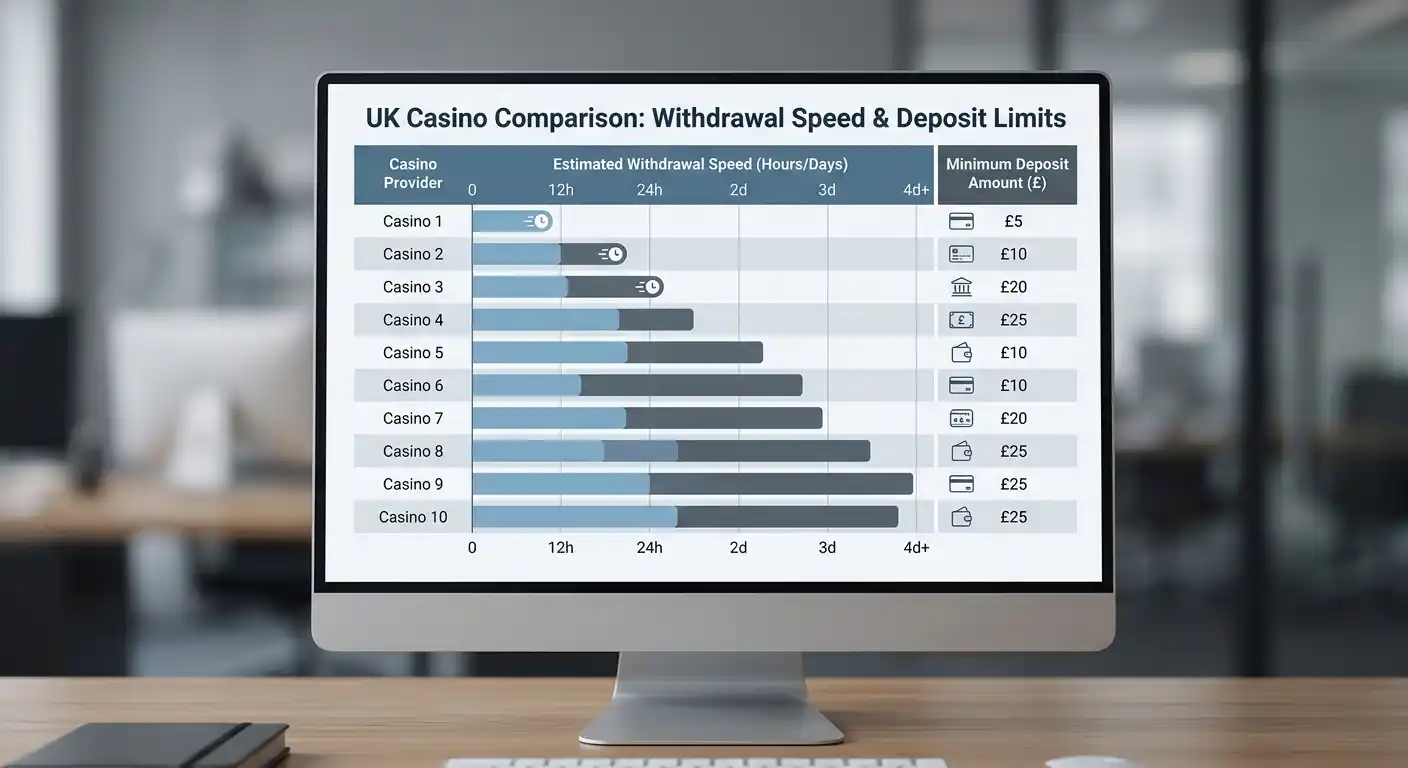
The row order reflects payment convenience rather than brand size. Bet365 leads on stated withdrawal processing speed. Grosvenor offers Fast Withdrawal for e-wallets but standard card timings. The £5 floor (Bet365, William Hill, Ladbrokes, Grosvenor, Paddy Power) undercuts the £10 standard at digital-first entrants, though the two-pound gap rarely determines site choice in practice.
Can I use a debit card at UK online casinos in 2026?
Yes. All UKGC-licensed online casinos accept Visa Debit and Debit Mastercard as standard payment methods. The UK Gambling Commission banned credit cards for gambling on 14 April 2020, but debit cards remain explicitly permitted and are the primary deposit method at every legal UK operator.
Bet365 Casino
Bet365 operates under Hillside (New Media) Limited with UKGC licence 55148. The Coates family owns the business outright, making it one of the few remaining privately-held major operators in a market dominated by consolidated groups. Revenue and player counts consistently place Bet365 in the top tier of UK-licensed gambling operators.
The casino sits alongside a sportsbook and live betting vertical under one account. Game library runs to 400+ slots, live dealer tables, and jackpot titles. Minimum deposit sits at £5 across Visa Debit, Debit Mastercard, PayPal, and Apple Pay. The welcome offer shifts between matched deposit bonuses and free-spin packages depending on promotional calendar.
What distinguishes Bet365 from the pack is stated withdrawal processing speed: the casino commits to approving payouts within 2-4 hours of request, then handing off to bank clearing (which adds the standard 1-3 business days for card returns via Faster Payments). That 2-4 hour approval window beats the 24-48 hour norm at most competitors. Whether the stated timeline holds under load and across all account statuses is harder to verify without extended testing, but the policy exists in writing and players report faster-than-average cashouts. No transaction fees on debit card deposits or withdrawals.
William Hill Casino
William Hill operates under WHG (International) Limited, UKGC licence 39225. The brand carried the William Hill name through decades of UK high-street dominance before Caesars Entertainment acquired it in 2021, then sold the non-US assets to 888 Holdings in 2022. That ownership churn has not disrupted the UK online operation, which continues under the original UKGC licence.
Founded in 1934 as a retail bookmaker, the brand went online in 1998 — early enough to establish recognition before the remote gambling licensing framework arrived in 2014. The casino vertical runs at williamhill.com and vegas.williamhill.com, with 1000+ slots, live dealer tables, and exclusive William Hill titles. Visa Debit, Debit Mastercard, PayPal, Apple Pay, Skrill, and Neteller all clear at the £5 minimum.
The distinguishing feature here is heritage rather than innovation. William Hill is not the fastest on withdrawals (1-5 business days to debit card, though PayPal clears within 24 hours) and does not lead on welcome-offer value. It occupies the middle of the UK market: trusted, steady, and functionally competent without aggressive differentiators. For players who grew up passing William Hill shops on every high street, that familiarity holds weight. For new entrants assessing operators purely on speed and digital UX, the brand does not stand out. Closed-loop withdrawal policy applies: funds return to the deposit method before excess winnings route elsewhere.
Ladbrokes Casino
Ladbrokes operates under LC International Limited, UKGC licence 54743, as part of the Entain Group (formerly GVC Holdings). The Entain stable includes Coral, Foxy Bingo, PartyPoker, and a dozen other brands following years of M&A consolidation. Ladbrokes itself dates to 1886, making it one of the oldest surviving UK gambling brands still operating under its original name.
The casino product includes 2000+ slots, live dealer tables, and exclusive titles. Visa Debit, Debit Mastercard, PayPal, and Apple Pay all work at the £5 minimum. Account portability across Entain brands exists in theory — one KYC process unlocks access to multiple sites — though the practical benefit depends on whether you use sister brands.
Ladbrokes differentiates itself through welcome-offer structure: free spins with zero wagering requirement. That is unusual in the UK market post-2020, where most operators attach 10x-40x wagering to bonus winnings. The zero-wager spins carry a capped max cashout (typically £50-£100), but anything won within that ceiling withdraws as real cash immediately. For players allergic to rollover requirements, that clarity matters more than headline bonus size.
Withdrawal timing follows the 1-3 day standard for debit cards once the casino approves the request. E-wallets clear faster. Entain Group disclosed a £5 million UKGC fine in 2024-2025 for anti-money laundering failures across its estate, though the violation was systemic rather than Ladbrokes-specific and the site remains fully licensed and operational.
Sky Vegas
Sky Vegas operates under Sky Betting & Gaming, owned by Flutter Entertainment — the parent group that also controls Paddy Power, Betfair, and PokerStars. The Sky Vegas brand launched in 2005 as a pure online casino with no retail heritage, riding Sky’s satellite TV and broadband brand recognition into the gambling market.
The product focuses on slots (500+ titles) with live dealer and table games as secondary offerings. Visa Debit, Debit Mastercard, and PayPal work at the £10 minimum — one notch above the £5 floor at legacy competitors. That extra fiver gates welcome-offer eligibility at most digital-first operators, creating an effective price floor for bonus hunters.
Sky Vegas distinguishes itself through mobile-first UX and the implied trust transfer from the Sky brand. The site shares backend infrastructure with Paddy Power Games and Betfair Casino under the Flutter umbrella, so cashier mechanics and game libraries overlap even as the front-end branding diverges. Withdrawals state "processed immediately" in marketing materials, though that refers to e-wallet routes; debit card returns still follow the 1-3 day bank-clearing window that no operator can circumvent. Instant deposits across all methods. Part of Flutter Entertainment since the 2018 Stars Group acquisition finalized the group’s consolidation.
Grosvenor Casinos Online
Grosvenor operates under Genting Casinos UK Limited, owned by Malaysia’s Genting Group. The Grosvenor brand established itself in 1970 through physical casinos — the company now runs 55+ land-based locations across the UK, giving it brick-and-mortar credibility that pure online operators cannot replicate.
The online vertical launched in 2007. Game library includes 400+ slots, live dealer tables, and casino classics. Visa Debit, Debit Mastercard, PayPal, Apple Pay, and Paysafecard all accept deposits at the £5 minimum. Lower-stakes tables cater to casual players rather than high rollers, and the live dealer offering leans into the land-based casino heritage with studio production values above the affiliate-site norm.
Grosvenor’s payment hook is Fast Withdrawal: PayPal and Instant Bank Transfer clear within 15 minutes (stated policy) once the casino approves the request. That speed applies only to e-wallet and open-banking routes, not to debit card returns — card networks impose their own clearing windows (1-3 business days via Faster Payments) that casinos cannot compress. For players who deposit by card but are willing to withdraw via PayPal, the Fast Withdrawal option delivers same-day liquidity. For players wed to card-in/card-out flows, the standard timeline applies. No deposit fees on any method.
888 Casino
888 Casino operates under 888 UK Limited, part of 888 Holdings PLC. Founded in 1997, it ranks among the first wave of online casinos still operating under recognizable names. The company went public on the London Stock Exchange in 2005, giving it transparency obligations that privately-held competitors avoid. In 2022, 888 Holdings acquired William Hill from Caesars Entertainment, creating a UK market consolidation that now positions 888 as both a standalone casino brand and the parent of a legacy bookmaker.
The casino runs at 888casino.com with 300+ slots, live dealer tables, jackpot games, and exclusive 888 titles. Proprietary software sits alongside third-party content, with Millionaire Genie jackpot slots as a long-standing brand signature. Visa Debit, Debit Mastercard, PayPal, Apple Pay, Neteller, and Skrill all work at the £10 minimum.
Gibraltar headquarters and LSE listing position 888 as an international operator with a UK licence rather than a UK-native brand. The UKGC licence has been active since the 2014 remote gambling framework arrived, supplemented by Gibraltar and Malta licences for other markets. Minimum deposit of £10 matches the digital-first entrants rather than the £5 floor at legacy brands. A July 2026 policy change banned corporate cards (business debit/credit) from making deposits, reflecting tighter anti-money laundering scrutiny rather than consumer payment restrictions. Withdrawals take 1-5 days to debit cards after casino approval.
LuckyMate
LuckyMate holds UKGC licence 48789. Ownership structure and parent company remain undisclosed in public filings, marking it as a newer entrant without the legacy baggage or corporate transparency of LSE-listed operators. The site markets itself as a mobile-first casino and sportsbook hybrid, positioning against heritage brands with "instant withdrawal" messaging (which refers to e-wallet speed; debit cards still follow standard clearing).
The game library claims 5000+ slots, though that figure aggregates variants and reskins of the same base titles — a common count-inflation tactic across affiliate-marketed casinos. Visa Debit, Debit Mastercard, PayPal, Apple Pay, and Trustly all accept deposits at the £10 minimum. The welcome offer runs £10 deposit for 50 free spins on Big Bass Splash at £0.10 per spin, with no wagering requirement on spin winnings but a £100 max cashout cap.
LuckyMate’s value proposition is simplicity over heritage: lower wagering requirements on bonuses, streamlined KYC, and a mobile-responsive cashier that does not assume desktop as the default experience. Launch date is not widely disclosed, but its online presence and UKGC licence issuance suggest a post-2020 market entry. Withdrawal timing follows the 1-3 day standard for debit cards once casino approval clears. No public corporate parent means less regulatory scrutiny disclosure than LSE-listed competitors, though the UKGC licence itself imposes the same operational requirements across all licensees regardless of ownership transparency.
Casumo
Casumo operates under Casumo Services Limited with UKGC licence 58927. Founded in Sweden in 2012, the brand entered the UK market after the 2014 remote gambling licensing framework arrived. Ownership passed through Kindred Group affiliates before reverting to independent status under current management, giving it a corporate history more complex than its design-forward branding suggests.
The casino differentiates itself through gamification: players progress through levels, earn trophies, and unlock rewards beyond traditional deposit-match bonuses. That progression mechanic runs parallel to the standard casino offering (2000+ slots, live dealer, table games) rather than replacing it. Visa Debit, Debit Mastercard, Trustly, and Zimpler work at the £10 minimum. Scandinavian design aesthetic — clean, minimal, mobile-first — sets visual tone.
Casumo positions itself as the "adventure casino" with UX that reads younger and less stuffy than legacy UK bookmakers. For players who want slot depth and a progression system that mimics video game mechanics, the brand delivers. For players seeking the fastest withdrawals or the lowest deposit floor, nothing here beats Bet365 or the £5-minimum competitors. Withdrawal timing follows the standard 1-3 days to debit card after casino approval. Known for NetEnt and Microgaming content depth, reflecting the brand’s Scandinavian roots where those providers dominate.
Betway Casino
Betway operates under Betway Limited, part of Super Group (SGHC Limited). The parent company dual-listed on the New York Stock Exchange and Johannesburg Stock Exchange in 2021, giving it public-company disclosure obligations across multiple jurisdictions. Malta headquarters place it in the same international-operator category as 888, licensed in the UK but not UK-native.
The Betway brand launched in 2006 with a sportsbook focus that remains primary. Casino sits as a secondary vertical alongside the sports product. 500+ slots, live dealer tables, and table games fill the library. Visa Debit and Debit Mastercard work at the £10 minimum, matching digital-first competitors rather than the £5 floor at Bet365 and William Hill.
Betway differentiates itself through sports sponsorships — Premier League partnerships, esports teams, high-visibility branding — that position the casino as an add-on to the sportsbook rather than a standalone product. For players who came to Betway for football betting and discovered the casino vertical, the integrated account makes sense. For players seeking the deepest slot library or fastest casino withdrawals, Betway does not lead on either metric. Withdrawal timing sits at 1-3 days to debit card after casino approval. eCOGRA certification (third-party fairness auditing) provides independent verification of game RTPs, a transparency layer not all operators maintain.
Paddy Power Games
Paddy Power operates under PPB Entertainment Limited, part of Flutter Entertainment. The brand launched in Ireland in 1988 as a retail bookmaker before going online in 2000. The 2016 merger with Betfair created Paddy Power Betfair, later rebranded as Flutter Entertainment to reflect the group’s portfolio expansion (Sky Vegas, PokerStars, FanDuel in the US).
The casino vertical runs at paddypower.com alongside sportsbook and bingo products. 400+ slots, live dealer tables, and exclusive Paddy Power branded games fill the library. Visa Debit, Debit Mastercard, and PayPal work at the £5 minimum — Flutter’s standard across its UK brands. Account infrastructure shares backend with Sky Vegas and Betfair Casino under the group umbrella.
Paddy Power’s distinguishing feature is edgy marketing: novelty bets, provocative campaigns, and a tone that reads more irreverent than the corporate-speak at Entain or 888. That branding extends to the casino product without fundamentally altering cashier mechanics or withdrawal speed. Debit card returns take 1-3 days once casino approval clears; PayPal clears faster. UKGC licence active since 2014 framework. Flutter Entertainment ranks as the world’s largest online gambling group by revenue, giving Paddy Power liquidity and regulatory stability even as the brand maintains its underdog aesthetic.
How Debit Card Deposits Work at UK Casinos
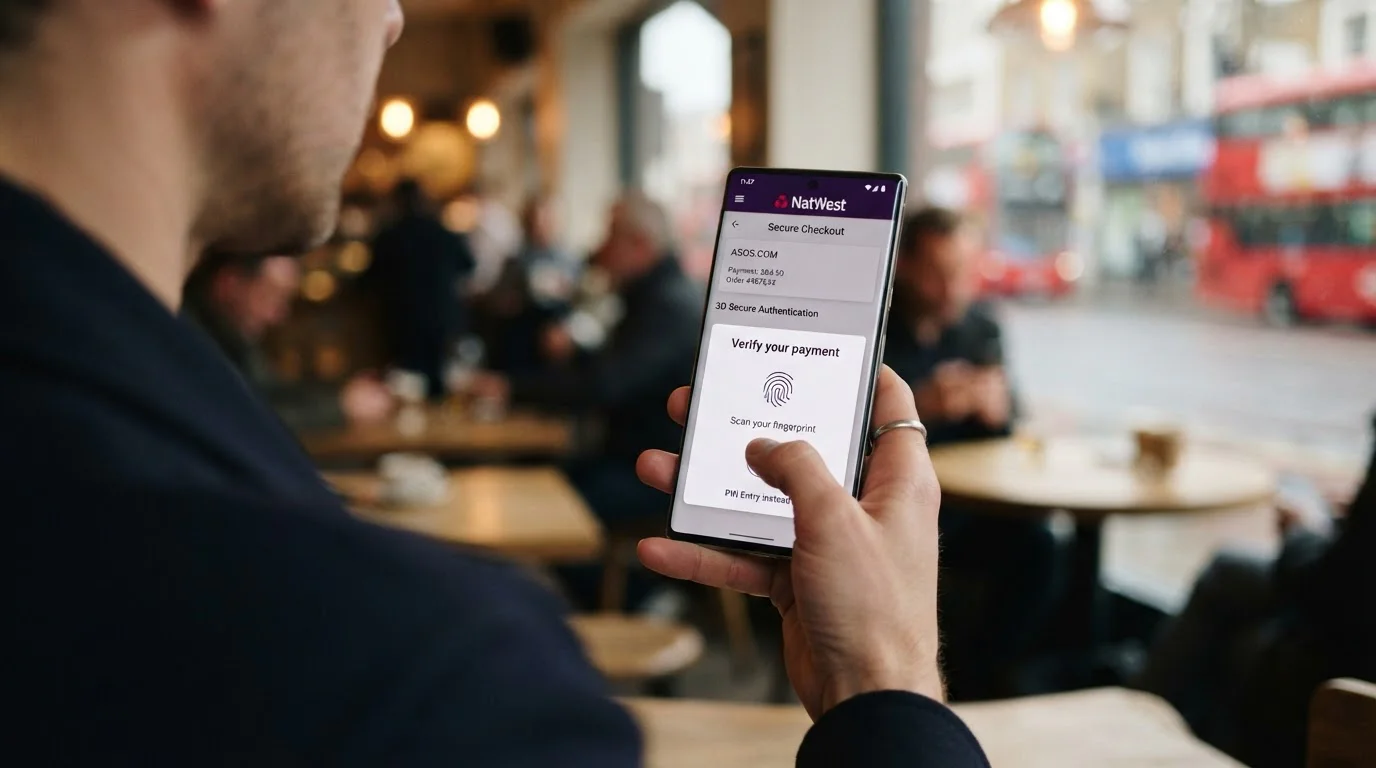
Debit card deposits at UKGC-licensed casinos follow a standard card-not-present transaction flow mandated by UK payment regulations. The process takes seconds from initiation to balance update, though several authentication layers run invisibly between the player clicking "deposit" and funds landing in the casino account.
The Deposit Process Step-by-Step
A player enters the card number, expiry date, and CVV security code into the casino cashier. That data transmits through an encrypted connection to the casino’s payment processor, which forwards the transaction to the card network — Visa or Mastercard depending on the card. The card network routes the authorization request to the issuing bank (the player’s bank).
The issuing bank checks account balance and available funds. If sufficient funds exist and no fraud flags trigger, the bank approves the transaction and sends confirmation back through the card network to the casino’s processor. The casino receives approval and credits the player’s balance instantly. Total elapsed time: typically 2-10 seconds for a clean transaction with no authentication friction.
Three points of failure exist in this chain. Insufficient funds produce an instant decline. Fraud detection systems at the issuing bank may flag casino transactions even when funds exist, particularly at challenger banks like Monzo and Revolut that default to stricter merchant-category screening. And 3D Secure authentication (covered below) adds a mandatory step that occasionally breaks if the player’s banking app is unavailable or the redirect loop fails.
3D Secure Authentication Explained
3D Secure is the authentication protocol that redirects debit card users to their banking app or a verification page during the deposit process. Visa calls it "Verified by Visa"; Mastercard calls it "Mastercard SecureCode." Both implement the same underlying standard: when a player initiates a card deposit, the casino triggers a 3D Secure check that sends the player to their bank’s verification interface.
The player confirms the transaction through their banking app (biometric authentication, PIN, or SMS code depending on bank setup) or enters a one-time password sent via SMS. Once the bank confirms the player authorized the transaction, control returns to the casino and the deposit clears. This step is mandatory under UK Strong Customer Authentication rules for online gambling transactions.
What is 3D Secure and why do I need it for casino deposits?
3D Secure is a card authentication protocol that verifies you authorized the debit card transaction. When you deposit at a UK casino, the cashier redirects you to your banking app or a verification page where you confirm the payment via biometric authentication, PIN, or SMS code. This step is legally required under UK Strong Customer Authentication rules and protects against unauthorized card use.
3D Secure adds friction — an extra step, an app redirect, occasional technical failures when the verification loop breaks — but also blocks card fraud. If someone steals your card details, they cannot complete a casino deposit without access to your banking app or SMS codes. The authentication requirement applies to all UKGC-licensed operators; offshore casinos may skip it, creating a fraud risk that UK regulation explicitly avoids.
Debit Card Withdrawals — Timing and Process

Debit card withdrawals at UK casinos take 1-5 business days from request to funds landing back in your bank account. That range obscures two distinct stages: casino approval (which the operator controls) and bank clearing (which the card network and Faster Payments system control). Understanding where delays occur clarifies which operators actually deliver faster payouts versus which merely restate the industry-standard timeline.
The Closed-Loop Rule
UKGC anti-money laundering regulations require casinos to return winnings via the same payment method used for deposit, up to the amount deposited. This is the closed-loop rule. If you deposit £100 by debit card and win £300, the first £100 of your withdrawal returns to that debit card. The excess £200 routes to an alternative method — typically bank transfer or e-wallet depending on what the casino supports and what you have verified on your account.
The closed-loop rule exists to prevent card deposits funding e-wallet withdrawals, which would allow players to "clean" funds through the casino by depositing stolen card details and withdrawing to an anonymous e-wallet. Forcing the first withdrawal back to the deposit card creates an audit trail that ties the funds to a verified bank account.
In practice, the closed-loop rule means debit card users cannot avoid card withdrawal timing even if they prefer PayPal for speed. The first payout returns to the card at 1-3 day speed. Only after withdrawing the full deposited amount can subsequent payouts route to faster methods.
What Happens During the 1-3 Day Window
The 1-3 day withdrawal timeline breaks into two phases: casino processing and bank clearing.
Casino processing (0-24 hours, sometimes faster): The operator verifies the withdrawal request is legitimate (account in good standing, no bonus wagering incomplete, KYC documentation submitted and approved), checks for fraud indicators, and approves the payout. This is the stage where operator speed diverges. Bet365 states 2-4 hour approval. Most competitors take 12-24 hours. Some smaller operators stretch to 48 hours or hold withdrawals in "pending" status for manual review.
Once the casino approves the withdrawal, it initiates a card refund transaction through its payment processor. The refund posts to the card network (Visa or Mastercard) as a reversal of the original deposit transaction, even though time has passed and the withdrawal may exceed the deposit amount within closed-loop limits.
Bank clearing (1-3 business days): The card network processes the refund and sends it to your issuing bank via the Faster Payments network (the UK’s real-time payment infrastructure). Despite "Faster Payments" branding, card refunds do not clear instantly — they follow the standard 1-3 business day cycle that banks use for non-instant card transactions. Your bank receives the funds and credits your account.
This is where casino control ends. No operator can compress bank clearing time because the card networks and Faster Payments system impose their own processing windows. When a casino advertises "instant withdrawals," it refers to e-wallet routes (PayPal, Skrill, Neteller) that bypass card networks entirely. Debit card returns are never instant, regardless of which casino you use.
Weekend and bank holiday timing extends the window. A withdrawal approved Friday evening will not reach your bank until Monday at earliest, and may not credit your account until Tuesday or Wednesday depending on bank processing schedules.
How long do debit card withdrawals take at UK casinos?
Debit card withdrawals take 1-5 business days at UK casinos. The timeline splits into casino approval (0-24 hours for most operators, 2-4 hours at Bet365) and bank clearing (1-3 business days via Faster Payments). Faster operators compress the approval phase but cannot accelerate bank clearing, which the card networks and your bank control. Weekends and bank holidays extend the total window.
Can I withdraw more than I deposited via debit card?
Yes, but only up to the amount you deposited via that card. UKGC anti-money laundering rules require casinos to return funds to your deposit method first (the closed-loop rule). If you deposit £100 by debit card and win £300, the first £100 returns to your card and the remaining £200 routes to an alternative method like bank transfer or e-wallet once you have withdrawn the full deposited amount back to the card.
Which Debit Cards Work — Visa, Mastercard, and Maestro
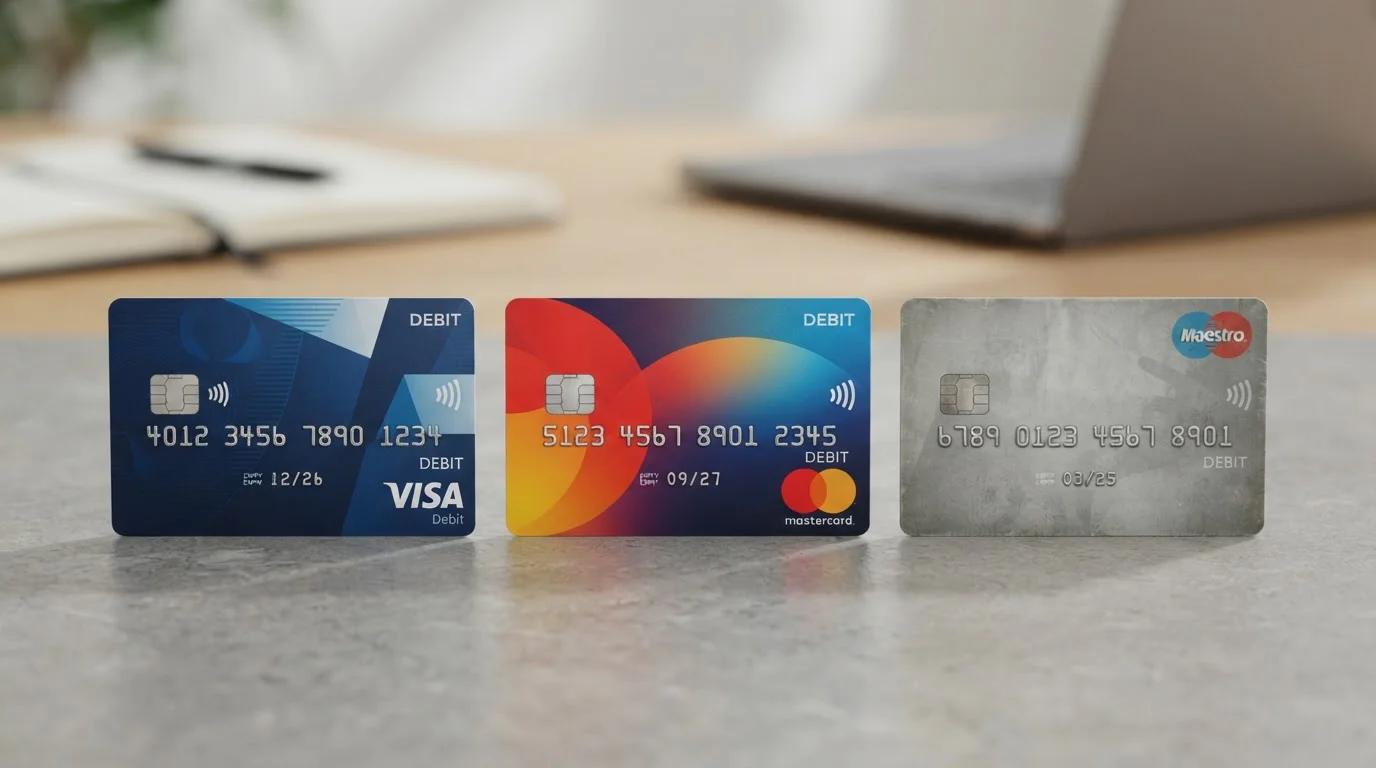
All UKGC-licensed casinos accept Visa Debit and Debit Mastercard as standard. Maestro — Mastercard’s older debit brand — was phased out in July 2023 and no longer works at most operators. Card network acceptance is near-universal, but bank-specific friction occasionally blocks transactions even when the card itself is technically compatible.
Visa Debit and Debit Mastercard function identically from the player’s perspective. Both clear deposits instantly, both follow the same 1-3 day withdrawal timeline, both trigger 3D Secure authentication, and both incur zero transaction fees at UKGC-licensed operators. Interchange fees (the percentage the card network charges merchants) sit around 0.2-0.3% for debit cards under EU caps that the UK retained post-Brexit, but casinos absorb that cost rather than passing it to players.
| Card type | Acceptance at UKGC casinos | Deposit speed | Withdrawal timeline | Player fees | Status in 2026 |
|---|---|---|---|---|---|
| Visa Debit | Universal | Instant | 1–3 days | Zero (3D Secure applies) | Standard |
| Debit Mastercard | Universal | Instant | 1–3 days | Zero (3D Secure applies) | Standard |
| Maestro | Declining, accepted only until expiry | — | — | — | Phased out July 2023, no new cards issued |
Maestro was Mastercard’s PIN-based debit brand, historically more common in Europe than in the UK. Mastercard announced the phase-out in 2021 and stopped issuing new Maestro cards globally in July 2023. Existing Maestro cards continue working until expiry, but acceptance is declining as operators remove Maestro from cashier options. If you still hold a Maestro card, it will work at some UK casinos through 2026 but replacement with a standard Debit Mastercard is inevitable as your bank reissues cards on expiry.
Which debit cards work at UK online casinos — Visa, Mastercard, or Maestro?
Visa Debit and Debit Mastercard work at all UKGC-licensed casinos. Maestro (Mastercard’s older debit brand) was phased out in July 2023 — new Maestro cards are no longer issued, and existing cards work only until expiry. If your bank issued a Maestro card years ago, replace it with a standard Debit Mastercard for full compatibility going forward.
Bank-specific debit cards tied to Visa or Mastercard networks (Monzo, Revolut, Starling, Lloyds, Barclays, etc.) work technically, but some banks flag or block gambling transactions by default. Monzo and Revolut require players to whitelist merchant category code 7995 (gambling) in the banking app before casino deposits clear. Traditional high-street banks (Lloyds, HSBC, Barclays, NatWest) rarely block casino transactions, though all offer gambling-block tools that players can activate voluntarily.
Are Monzo and Revolut debit cards accepted at UK casinos?
Yes, Monzo and Revolut debit cards work at UK casinos, but both banks default to blocking gambling transactions until you manually whitelist them. In the Monzo or Revolut app, navigate to card settings and enable gambling transactions (merchant category code 7995). Once enabled, deposits clear instantly like any other Visa Debit or Debit Mastercard. If you attempt a casino deposit without whitelisting, the transaction declines even when funds exist in your account.
Credit Cards vs Debit Cards — The 2020 Ban Explained

The UK Gambling Commission banned credit card use for gambling on 14 April 2020. The ban applies to all UKGC-licensed operators — online casinos, sportsbooks, bingo sites, poker rooms, and lottery platforms. No exceptions exist for low-stakes play or specific game types. Debit cards, bank transfers, e-wallets, and cash (at retail locations) remain legal payment methods.
The Commission announced the ban on 14 January 2020, giving operators a three-month implementation window. The stated rationale focused on problem gambling risk: credit cards allow players to gamble with borrowed money, creating debt accumulation that debit cards (which draw on existing funds) do not replicate. The Commission cited research showing 22% of credit card users who gamble online were problem gamblers or at risk, compared to lower rates among debit card and e-wallet users.
Industry response split between public support and private concern about revenue impact. Operators complied with the ban under threat of licence revocation, though some reported deposit volume declines in the months following implementation. E-wallet adoption increased as players who previously used credit cards migrated to PayPal, Skrill, and Neteller as intermediaries — those platforms accepted credit card funding, then passed deposits to casinos as e-wallet transactions, creating a loophole the UKGC acknowledged but did not immediately close.
By 2026, the credit card ban is settled policy with no indication of reversal. Debit cards now handle the majority of UK online casino deposits, with e-wallets and open banking splitting the remainder. Offshore casinos licensed under MGA (Malta) or Curacao continue accepting UK players and credit cards, operating outside UKGC jurisdiction but accessible to British customers willing to forego UK regulatory protection.
Why are credit cards banned at UK casinos but debit cards allowed?
The UK Gambling Commission banned credit cards on 14 April 2020 to reduce problem gambling risk associated with gambling on borrowed money. Research showed 22% of online gamblers using credit cards were problem gamblers or at risk, compared to lower rates among debit card users. Debit cards draw on funds you already hold rather than credit, reducing debt accumulation risk. The ban applies to all UKGC-licensed operators; offshore casinos outside UK regulation may still accept credit cards.
Minimum Deposits and Fees
Minimum deposits at UK casinos accepting debit cards range from £5 to £10, with legacy high-street brands (Bet365, William Hill, Ladbrokes) anchoring the lower end and digital-first operators (LuckyMate, Casumo, Betway) clustering at £10. That £5 spread is narrow enough that it rarely determines site choice, but it functions as a price signal: £5 minimums cater to casual players and bonus testers, while £10 floors gate welcome offers behind a threshold that filters low-value accounts.
The £5 vs £10 distinction maps to bonus eligibility more than access. A £5 deposit at Bet365 qualifies for the welcome offer, making the lower floor a genuine entry point. A £5 deposit at a £10-minimum competitor does not exist — the cashier rejects the transaction. When a newer operator sets a £10 floor, it is screening for players willing to commit enough capital to justify the bonus cost. Welcome offers carry acquisition expense (free spins cost operators real money when players win and cash out), so a £10 minimum doubles the per-customer deposit compared to £5, improving unit economics even if it excludes price-sensitive players.
No UKGC-licensed casino charges transaction fees on debit card deposits or withdrawals. The card networks charge interchange fees to merchants (around 0.2-0.3% for debit cards), but operators absorb those costs rather than passing them to players. This is standard across the UK market: if a casino attempted to charge deposit or withdrawal fees on debit cards, players would migrate to the dozens of competitors offering zero-fee transactions.
Currency conversion fees apply if your debit card is denominated in a non-GBP currency and you deposit at a GBP-denominated casino. The card network handles conversion at interbank rates plus a markup (typically 1-3%), and your issuing bank may add another fee. For UK players using UK-issued debit cards at UK-licensed casinos, currency conversion does not occur and no related fees apply.
What is the minimum deposit with a debit card at UK casinos?
Minimum deposits range from £5 to £10 depending on operator. Bet365, William Hill, Ladbrokes, Grosvenor, and Paddy Power accept £5 deposits. Sky Vegas, LuckyMate, Casumo, Betway, and 888 Casino require £10. The £5 floor is more common at legacy brands; £10 minimums are standard at newer digital-first operators and often tied to welcome-offer eligibility thresholds.
Do UK casinos charge fees for debit card deposits or withdrawals?
No. All UKGC-licensed casinos absorb card network interchange fees (around 0.2-0.3% for debit cards) rather than charging players. Deposits and withdrawals via Visa Debit or Debit Mastercard incur zero transaction fees at every operator covered in this guide. Currency conversion fees apply only if your card is denominated in a non-GBP currency, in which case the card network and your bank handle conversion with their own markups.
Common Issues and How to Fix Them
Debit card deposits fail for three reasons: insufficient funds, bank-side gambling blocks, or 3D Secure authentication errors. The first is self-explanatory. The second and third create friction even when funds exist and the card is valid.
Bank gambling blocks: Some UK banks — particularly Monzo, Starling, and Revolut — default to blocking transactions to gambling merchants (merchant category code 7995). The transaction declines even when your account holds sufficient funds. Fix: open your banking app, navigate to card controls or spending limits, and enable gambling transactions. This is a one-time setting change; once enabled, future deposits clear normally. Traditional high-street banks (Lloyds, Barclays, NatWest, HSBC) rarely block gambling by default, though all offer gambling-block tools that players can activate voluntarily through online banking or app settings.
The gambling block exists as a harm-reduction feature rather than a technical limitation. Banks implemented these controls following pressure from problem gambling charities and the Financial Conduct Authority, which regulates UK banks but not gambling operators. The default-block approach at challenger banks reflects their digital-first customer base and stricter risk posture. A player who wants to disable the block can do so in seconds, but the friction of requiring an active opt-in supposedly prevents impulsive gambling decisions funded by card debt.
In practice, the block creates support burden. Players attempt deposits, see a decline, assume the casino rejected the transaction, and contact casino support. The casino’s fraud system shows no attempted transaction — the decline happened at the bank before the authorization request ever reached the card network. The player then contacts their bank, discovers the gambling block, and enables transactions. Total time wasted: 10-30 minutes depending on support queue length. Multiply across thousands of new players per month and the friction compounds into a meaningful UX drag.
3D Secure failures: The 3D Secure redirect occasionally breaks when your banking app is unavailable, the verification page times out, or the redirect loop between casino and bank fails to complete. Symptoms: the deposit window hangs, or you receive an error after entering your authentication code. Fix: close the deposit window and retry. Ensure your banking app is updated to the latest version and that you have mobile data or Wi-Fi connectivity. If 3D Secure failures persist across multiple attempts, contact your bank’s support line — occasionally the bank’s 3D Secure service experiences outages that affect all online transactions, not just casinos.
3D Secure technical failures stem from the redirect architecture. The casino cannot complete the deposit without confirmation from your bank that you authenticated the transaction. If the redirect loop breaks — your banking app crashes, the verification page times out, or the return URL fails to resolve — the deposit hangs in limbo. The casino sees an incomplete authorization and cannot credit your balance. Your bank may or may not have reserved the funds depending on where the failure occurred in the sequence.
Retrying usually resolves transient failures. If the problem persists, the issue likely sits at the bank’s 3D Secure service rather than the casino’s payment processor. Banks outsource 3D Secure infrastructure to third-party providers (e.g., RSA, Visa’s Cardinal Commerce), and those services occasionally experience regional outages that affect all online card transactions.
Expired or incorrect card details: Self-evident but common. CVV typos, transposed expiry dates, or using an expired card all produce instant declines. Double-check card details before contacting support. The casino’s cashier typically highlights which field triggered the rejection (e.g., invalid CVV, expired card), making diagnosis straightforward.
Daily deposit limits: Some banks impose daily spending caps on debit cards, separate from account balance. A £500 daily limit would block a £600 casino deposit even if £2000 sits in the account. Check your banking app’s card limits or call your bank to raise the daily cap temporarily. These limits exist as fraud protection — a stolen card cannot drain your account in one transaction if daily spending is capped at £500. For players making large deposits, the limit becomes an obstacle rather than protection. Most banks allow temporary limit increases through the app or via phone support.
Card network outages: Rare but disruptive. Visa or Mastercard network outages affect all transactions using that network, not just casino deposits. Symptoms: all cards from that network decline simultaneously, regardless of issuing bank or casino. Fix: wait for the network to restore service (outages typically resolve within 30-60 minutes) or switch to an alternative payment method (e-wallet, bank transfer). Casino support cannot resolve network-level outages — the issue sits upstream at Visa or Mastercard infrastructure.
Why is my debit card being declined at an online casino?
Debit card declines at UK casinos occur for several reasons: (1) Bank gambling block — Monzo, Revolut, and Starling default to blocking gambling transactions until you enable merchant category code 7995 in your banking app. (2) Insufficient funds or daily card limit exceeded. (3) 3D Secure authentication failure — the verification redirect timed out or your banking app was unavailable. (4) Incorrect card details (CVV, expiry date). Check your banking app’s transaction controls first; most declines stem from bank-side blocks rather than casino rejection.
KYC Verification and First Withdrawal
UKGC regulations require all licensed operators to verify player identity before processing the first withdrawal. This is Know Your Customer (KYC) verification, an anti-money laundering control that confirms you are who you claim to be and that the funds being withdrawn belong to you.
The casino will request two documents: proof of identity (passport, driving licence, or national ID card) and proof of address (utility bill, bank statement, or council tax bill dated within the last three months). Upload these documents through the casino’s account settings or KYC portal. Most operators process verification within 24-48 hours during business days.
Until verification completes, the casino holds withdrawal requests in pending status. You can still play, deposit, and accumulate winnings, but funds will not leave the casino’s balance and return to your debit card until KYC clears. Some operators allow small withdrawals (£50-£100) before full KYC, but most enforce strict document requirements for any payout.
The friction here is intentional. KYC verification creates a cooling-off period between winning and withdrawing, giving players time to reconsider cashing out and potentially continuing to play. From the casino’s perspective, every withdrawal that gets reversed (player cancels the pending payout and gambles the funds back) improves retention metrics. From the regulator’s perspective, KYC verification prevents minors from gambling and reduces money-laundering risk by tying casino accounts to verified identities.
Submit KYC documents immediately after registration rather than waiting until your first withdrawal. Proactive verification eliminates the delay when you do want to cash out, and it signals to the casino’s fraud systems that you are a legitimate player rather than a bonus abuser or fraudster. Operators sometimes fast-track withdrawals for players who verified documents early, though no formal policy guarantees this treatment.
Enhanced due diligence applies to large withdrawals or players who exceed certain deposit thresholds. The casino may request additional documents: bank statements showing the source of deposited funds, employment verification, or a video call to confirm identity. UKGC affordability checks (not yet mandatory but increasingly common in 2026) push operators to verify that players can afford their gambling spend, particularly at high-roller levels.
Debit Cards vs E-Wallets and Open Banking

Debit cards compete with e-wallets (PayPal, Skrill, Neteller) and open banking (Pay by Bank, Trustly) as deposit methods at UK casinos. Each has trade-offs in speed, convenience, and withdrawal timing.
Debit cards offer universal acceptance and no intermediary account setup. If you hold a UK bank account, you already have a debit card. Deposits are instant. Withdrawals take 1-3 days due to card network clearing, and the closed-loop rule forces the first withdrawal back to the card regardless of whether you prefer an alternative method. No transaction fees at UKGC-licensed operators.
E-wallets (PayPal, Skrill, Neteller) require a separate account setup but deliver faster withdrawals. PayPal withdrawals clear within 24 hours at most UK casinos; Skrill and Neteller often match that speed. The trade-off: you must fund the e-wallet via debit card or bank transfer first, adding a step to the deposit flow. E-wallets also bypass the closed-loop rule — you can deposit by card and withdraw to PayPal, though some operators restrict this to prevent the exact card-to-e-wallet arbitrage the rule was designed to block.
E-wallet deposits sometimes exclude welcome bonuses. Operators learned that bonus abusers funded accounts via e-wallets, claimed the bonus, wagered it through, and withdrew via the same e-wallet — completing the cycle in hours without ever verifying identity or source of funds. To combat this, many UK casinos exclude e-wallet deposits from bonus eligibility, forcing players to use debit cards or bank transfer if they want the welcome offer.
Open banking (Pay by Bank, Trustly, Zimpler) connects directly to your bank account without a card transaction. Deposits are instant. Withdrawals return to the same bank account, often clearing within 24 hours because open banking bypasses card networks entirely. The trade-off: not all banks support open banking for gambling transactions, and the authentication flow (redirect to your banking app, approve the payment) adds friction similar to 3D Secure.
Open banking solves the card network clearing delay but introduces bank compatibility issues. Some banks (particularly Monzo and Starling, again) block open banking connections to gambling merchants or require manual approval for each transaction. For players at compatible banks, open banking delivers the fastest deposit-to-withdrawal cycle. For players at incompatible banks, the method simply does not work and debit cards remain the fallback.
The dominant method in 2026 remains debit cards, accounting for 60-70% of UK online casino deposits according to industry payment reports. E-wallets split 20-25%, open banking takes 5-10%, and niche methods (Paysafecard, cryptocurrency at non-UK-licensed operators) fill the remainder. The credit card ban cemented debit cards as the default rather than one option among many.
Responsible Gambling and Debit Card Controls
UKGC-licensed casinos offer deposit limit tools that apply across all payment methods, including debit cards. Set a daily, weekly, or monthly deposit ceiling through your account settings. Once the limit is reached, further deposits decline until the time window resets. The limit applies to gross deposits, not net wins or losses — a £100 daily limit means £100 can enter the account per day regardless of how much you withdraw.
Deposit limits sit alongside other responsible gambling tools mandated by the UKGC: session reminders (pop-up notifications after a set time), reality checks (display of total wagered and time played), self-exclusion (voluntary account closure for 6 months to 5 years), and GAMSTOP (national self-exclusion register that blocks access to all UKGC-licensed operators).
GAMSTOP registration prevents debit card deposits at any UK-licensed casino. The operator checks your details against the GAMSTOP register during account creation. If you appear in the register, registration fails and no account opens. This blocks access at the sign-up stage rather than during deposit, eliminating the window where a self-excluded player could fund an account and gamble.
Some players view these controls as overreach. Offshore casinos (MGA, Curacao) market themselves as "non-GamStop casinos" to players frustrated with UK regulation, accepting debit cards from UK players without GAMSTOP checks or UKGC-mandated limits. That choice trades regulatory protection for autonomy: offshore operators are not subject to UKGC dispute resolution, do not contribute to the UK gambling levy, and cannot be compelled to honor withdrawal requests if they refuse. For players who prioritize freedom over protection, the trade feels worth it. For players who prioritize safety and regulatory recourse, UKGC licensing remains the only viable option.
The credit card ban itself functions as a harm-reduction tool, with debit cards positioned as the "safer" payment method. The logic: debit cards draw on money you already have, while credit cards allow gambling on borrowed funds. That distinction holds when players use cards rationally. It breaks when players drain checking accounts via debit card, overdraft their accounts, or transfer balances between accounts to fund continued gambling. The card type matters less than the behavioral pattern, and debit cards do not eliminate problem gambling — they merely shift the funding source from credit to existing balances.
Banks’ voluntary gambling blocks on debit cards extend the harm-reduction layer. A player who sets up a Monzo gambling block cannot deposit at a casino without deliberately disabling the block, creating a friction point that (in theory) prompts reflection before gambling. Whether that friction meaningfully reduces harm or merely annoys recreational players remains debated. The tool exists, regulators and charities endorsed it, and banks implemented it to reduce their own reputational exposure to gambling harm.
Regional Considerations Within the UK
UKGC licensing covers Great Britain (England, Scotland, Wales) but not Northern Ireland, which operates under separate gambling laws. Online casino licensing in Northern Ireland follows UK norms in practice — operators with UKGC licences accept Northern Irish players without additional restrictions, and debit card deposits work identically.
Scotland and Wales operate under the same UKGC framework as England. No regional deposit limits, card acceptance differences, or regulatory variations exist within Great Britain. A debit card issued by a Scottish bank works at every UKGC-licensed casino accessible to an English player, and vice versa.
Local payment preferences diverge slightly by nation. Scots show higher e-wallet adoption than the GB average, likely influenced by the fintech-friendly Edinburgh ecosystem. Welsh players skew toward traditional banking methods (debit cards, bank transfers) over e-wallets, though data here is sparse. Northern Irish players use the same payment methods as GB players, with debit cards dominant.
High-street bank consolidation affects card acceptance indirectly. Bank mergers (Lloyds-HBOS, Lloyds-TSB, Santander-Abbey National) reduced the number of distinct card issuers in the UK market, centralizing fraud detection and gambling block policies. A player using an HBOS-issued card now encounters Lloyds’ transaction controls post-merger, potentially introducing gambling blocks that did not exist when the card was first issued under the HBOS brand.
The Future of Debit Cards at UK Casinos

Debit cards will remain the dominant UK casino payment method through the mid-2020s, barring regulatory changes that push the market toward open banking or ban card deposits outright. The UKGC has not proposed a debit card ban, and industry consultation documents suggest the regulator views debit cards as appropriately balanced between accessibility and harm reduction.
Open banking adoption will grow as banks complete infrastructure rollouts and players gain familiarity with account-to-account payment flows. Trustly, Zimpler, and Pay by Bank initiatives position open banking as faster than cards and more direct than e-wallets, but adoption curves depend on bank compatibility and player trust. A significant minority of UK adults remain uncomfortable granting third-party apps direct access to their bank accounts, even for payment purposes.
Central Bank Digital Currency (CBDC) — a digital pound issued by the Bank of England — remains under exploration as of 2026 but not yet implemented. If launched, a digital pound could function as an instant-settlement payment method at casinos, bypassing card networks and bank clearing delays entirely. Implementation timeline is uncertain; CBDC pilots began in 2024-2025 but full rollout remains years away.
Cryptocurrency adoption at UKGC-licensed operators is negligible. Bitcoin and stablecoin deposits work at offshore casinos serving UK players, but UKGC regulations effectively prohibit crypto by requiring operators to verify source of funds — a standard that anonymized blockchain transactions cannot satisfy. Unless the UKGC softens anti-money laundering rules to accommodate crypto (unlikely given the regulator’s conservative stance), debit cards and fiat banking methods will retain their monopoly at licensed operators.
The credit card ban’s success — measured by lack of industry pushback and absence of reversal proposals — suggests the UKGC will not revisit the debit-card-only policy. Operators adapted, players migrated to alternative methods, and problem-gambling metrics (to the extent they are publicly reported) did not spike following the ban. The regulatory momentum points toward more restrictions (affordability checks, stake limits, mandatory cooling-off periods) rather than loosening payment controls.
Created by the ”Payments-casino-uk (9)” editorial team.