Best Online Casino Payment Methods UK: The Honest Breakdown 2026
 Available in GB
Debit cards fund 100% of UKGC-licensed casinos. PayPal keeps your details off the casino’s server. Paysafecard won’t take your winnings back. Boku caps you at £30 per go, which might be the point.
The UK casino payment landscape splits into five categories: debit cards, e-wallets, mobile wallets, bank transfers, and prepaid vouchers. Each trades speed for control, privacy for universality, or convenience for cost. Credit cards vanished in April 2020 under UKGC rules, leaving only debit-funded routes. Some methods deposit instantly but force you to cash out another way. Others promise fast withdrawals but exclude you from the welcome bonus.
This guide maps every major payment method at UK online casinos in 2026: what each one actually costs, how fast your money moves, which methods lock you out of both directions, and where regulation draws the line. No "it depends" padding. Concrete figures, tested speeds, and the trade-offs that matter when you’re choosing how to move your money.
Table of Contents
- UK Casino Payment Methods: The Complete Landscape
- Debit Cards: The UK Default
- E-Wallets: Privacy and Speed
- Mobile Payments: Tap and Play
- Bank Transfers: Traditional and Instant
- Prepaid Vouchers: Cash and Control
- Speed Comparison: Which Methods Pay Out Fastest?
- Fees and Costs: What You Actually Pay
- Bonus Eligibility: Which Methods Qualify?
- UK Regulation and Payment Methods
- Choosing the Right Payment Method for You
UK Casino Payment Methods: The Complete Landscape
The Five Main Payment Categories
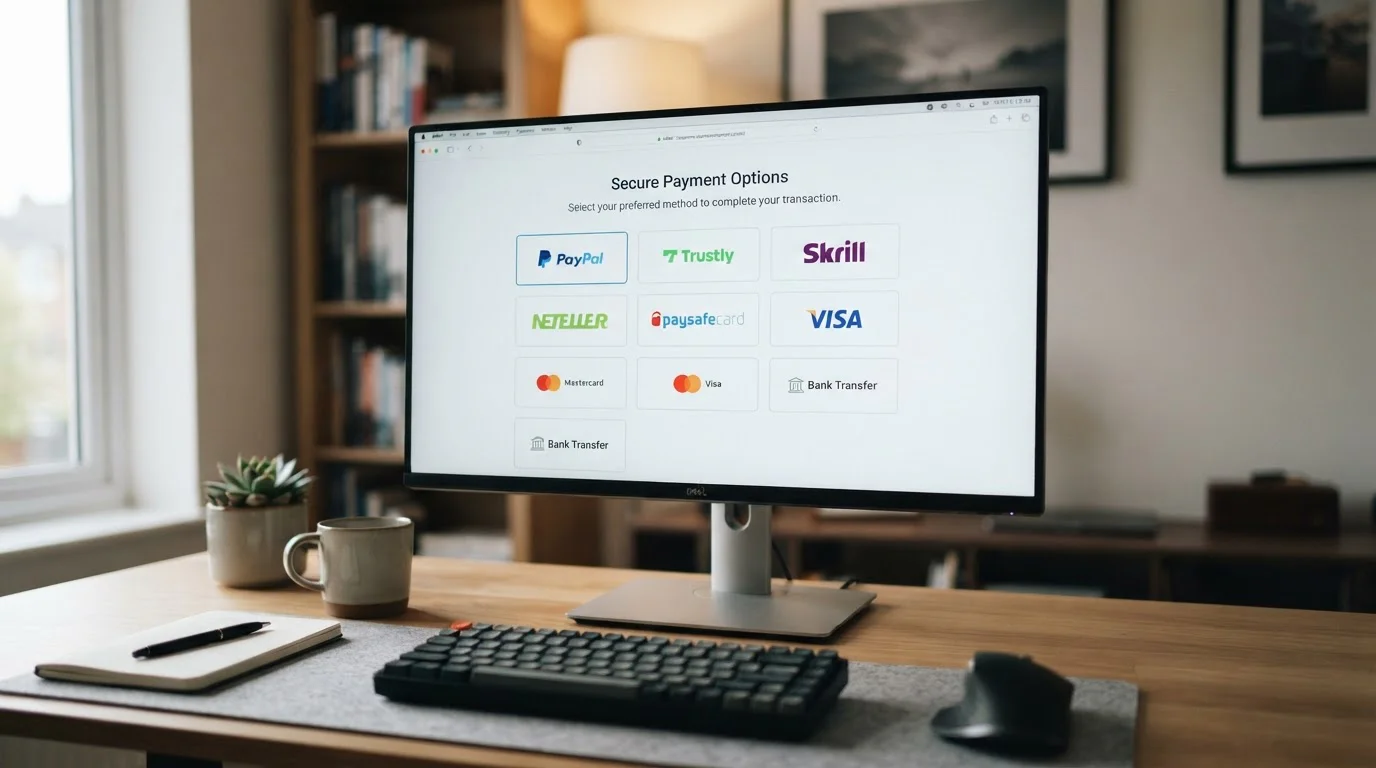
UK-licensed casinos route your money through five main channels. Debit cards anchor the field: Visa and Mastercard work everywhere, cost nothing to the player, and handle both deposits and withdrawals. E-wallets layer privacy between your bank and the casino: PayPal, Skrill, and Neteller dominate here, with secondary players like MuchBetter and Payz trailing behind. Mobile payments split into two branches: Apple Pay and Google Pay tokenize your existing card for biometric deposits, while pay-by-mobile services like Boku charge directly to your phone bill. Bank transfers divide into legacy manual transfers and instant Open Banking routes powered by Trustly. Prepaid vouchers, led by Paysafecard, let you fund with cash-purchased PINs but trap you at the deposit gate.
Each category answers a different priority. Debit cards trade speed for universality. E-wallets trade a separate account for privacy. Mobile payments trade limits for convenience. Bank transfers trade setup friction for directness. Prepaid vouchers trade flexibility for control. None of them is categorically superior. The right method depends on what you optimize for: fastest withdrawal, highest privacy, tightest budget control, or simplest workflow.
The UK Gambling Commission regulates the casinos, not the payment methods themselves. UKGC rules ban credit cards outright since April 2020, a line drawn after mounting evidence that borrowing to gamble correlates with problem gambling. The ban extends to e-wallet deposits funded by credit cards: operators must verify that wallet money comes from debit sources or bank transfers, not credit. Beyond that prohibition, every mainstream payment category remains available at UKGC-licensed sites. The Payment Services Regulations handle e-wallets and Open Banking. The FCA authorizes payment institutions. Mobile carriers and Ofcom govern phone-bill payments. Debit cards route through Visa and Mastercard networks under card-scheme rules. Prepaid vouchers fall under e-money regulations. The system is multi-layered, not monolithic.
How Deposits and Withdrawals Work at UK Casinos
Deposit mechanics are near-universal: instant confirmation across every method except traditional bank transfer. You select a payment option in the casino cashier, authenticate via card details or account login or biometric scan or voucher PIN, and funds land in your casino balance within seconds. Minimum deposits cluster between £5 and £10 at most operators, though some premium sites raise the floor to £20 or £25. Maximum deposits vary widely by operator and your VIP status, but standard accounts typically cap single transactions at £5,000 to £10,000. Payment methods impose their own ceilings: Boku hard-stops at £30 per transaction and £400 monthly, Paysafecard vouchers max out at £100 each unless you register an account and link multiple PINs.
Withdrawals introduce friction. Every UKGC casino requires identity verification before your first cashout: passport or driving licence, proof of address, and source-of-funds documentation for large amounts. This KYC check adds 24 to 72 hours to your first withdrawal, a one-time delay. Subsequent cashouts at the same casino skip that step if your account stays verified. The casino then processes your withdrawal request, a window that ranges from instant at the fastest operators to 24 to 48 hours at slower ones. Only after casino approval does the payment method’s own speed matter. E-wallets clear in under 24 hours once approved, often within an hour at top-tier casinos. Debit cards take one to three business days under standard processing, though Fast Funds technology can compress that to under an hour where supported. Bank transfers span three to five days traditionally, but Trustly’s Open Banking route completes in under an hour. Prepaid vouchers and pay-by-mobile services don’t accept withdrawals at all, forcing you to nominate an alternative method.
Minimum withdrawals typically sit between £10 and £20, driven by payment processing costs: operators discourage sub-£10 cashouts because gateway fees eat into margins. Maximum withdrawals per transaction mirror deposit limits for standard players, but high rollers negotiate bespoke arrangements. Withdrawal speed is the single most variable metric across UK casinos. The same payment method can deliver in 35 minutes at one site and 48 hours at another, purely down to how aggressively the operator batches and approves requests.
Bidirectional vs. Deposit-Only Methods
Not every payment method works in both directions. Debit cards, e-wallets, traditional bank transfer, and Trustly are bidirectional: deposit and withdrawal both supported, money flows both ways. Paysafecard, Boku, Apple Pay, and Google Pay are deposit-only: you can fund your account but cannot receive payouts through them. This asymmetry creates friction. If you deposit £50 via Paysafecard and win £200, the casino cannot return £200 to a voucher PIN. You must register a withdrawal method separately: a bank account, debit card, or e-wallet. Some casinos require a small test deposit from your nominated withdrawal method to verify ownership before processing the first payout.
The deposit-only trap catches casual players who assume funding and cashing out work symmetrically. Apple Pay and Google Pay appear bidirectional on the surface because they link to your bank account or card, but the casinos treat them as deposit facilitators only. Withdrawals bypass the mobile wallet and land directly in your underlying bank account or on your linked debit card, a detail buried in cashier fine print. Boku’s deposit-only nature is structural: you cannot reverse-bill a phone account, and carriers refuse payout traffic. Paysafecard’s limitation stems from anti-money-laundering rules: prepaid instruments accepting inbound funds without KYC would enable circular washing.
Table: UK Casino Payment Methods Comparison
| Method | Category | Deposit Speed | Withdrawal Speed | Fees to Player | Deposit-Only | Bonus Eligibility | Acceptance |
|---|---|---|---|---|---|---|---|
| Visa / Mastercard debit | Debit cards | Instant | 1-3 days (under 1h with Fast Funds) | None | No | Qualifies | 100% |
| PayPal | E-wallet | Instant | Under 24h (fastest: 35 min) | None (3-4% currency conversion) | No | Qualifies | 60-70% |
| Apple Pay | Mobile wallet | Instant | N/A (to bank/card, not wallet) | None | Yes | Qualifies | 40-50% |
| Google Pay | Mobile wallet | Instant | N/A (to bank/card, not wallet) | None | Yes | Qualifies | 40-50% |
| Skrill | E-wallet | Instant | Under 24h (fastest: 45 min) | 1.45% conversion + £1 instant withdrawal | No | Often excluded | 70-80% |
| Neteller | E-wallet | Instant | Under 24h | 1.50% conversion + £1-£5 instant withdrawal | No | Often excluded | 70-80% |
| Trustly (Open Banking) | Bank transfer | Instant | Under 1h (fastest: 50 min) | None | No | Qualifies | 50-60% |
| Paysafecard | Prepaid voucher | Instant | N/A | None (£3/month inactivity after 12 months) | Yes | Qualifies | 30-40% |
| Boku (pay by mobile) | Phone bill | Instant | N/A | 30p per transaction (some casinos absorb) | Yes | Qualifies | 40-50% |
Can I withdraw using a different method than I deposited with?
Yes, but with conditions. UKGC casinos prefer same-method withdrawals to prevent money laundering: if you deposited via debit card, they’ll push the payout back to that card unless you have a documented reason to use an alternative. For deposit-only methods like Paysafecard or Boku, you must register a withdrawal method separately. The casino will ask for bank details, a debit card, or an e-wallet account before processing your first cashout. Some operators require a small verification deposit from the withdrawal method to confirm you control it. If you deposited via multiple methods in one session, withdrawals are usually apportioned back to each source pro-rata until the deposited amounts are returned, then the remaining winnings go to your primary nominated method. High-roller accounts and VIP desks offer more flexibility, but standard players face tighter controls.

Debit Cards: The UK Default
Visa Debit
Visa Inc. operates the global payment network; UK banks issue debit cards on it. Every UKGC-licensed casino accepts Visa debit without exception. The card routes through Barclays, HSBC, Lloyds, Nationwide, or a neobank like Revolut, Monzo, or Starling. The casino sees a 16-digit number, expiry, and CVV, processes via a payment gateway like Worldpay or Adyen, and the transaction clears through Visa’s network in seconds.
Deposits land instantly. You enter card details at the cashier, confirm via 3D Secure 2.0 biometric or SMS code, and funds appear in your balance. Minimum deposits start at £5 to £10 depending on the operator. Maximums per transaction typically cap at £5,000 for standard accounts, higher for VIPs. Your issuing bank imposes its own daily online-spend limits, often £1,000 to £5,000 per day unless pre-arranged. No fees to the player: neither Visa nor the casino charges you for deposits. Some banks levy gambling-transaction fees buried in account terms, but that’s rare and bank-specific, not a Visa cost.
Withdrawals return to the same card. Standard processing takes one to three business days: the casino sends funds to Visa’s network, Visa routes to your issuing bank, the bank credits your account. Fast Funds technology, branded as Visa Direct, compresses that window to under an hour where supported. Not every casino enables Fast Funds, and not every issuing bank participates. The feature launched years ago but adoption remains patchy. At casinos supporting it, payouts land in minutes. At casinos without it, you wait the standard one-to-three-day cycle. Minimum withdrawals sit around £10 to £20. No withdrawal fees to the player under normal circumstances. Fast Funds carries no premium: it’s a routing upgrade, not a paid express lane.
Visa debit cards qualify for welcome bonuses at every UKGC casino. Credit cards used to qualify before the April 2020 ban; debit cards inherited that status with no penalty. The credit card prohibition stems from Licence Condition and Code of Practice 6.1.2, effective April 14, 2020, a UKGC rule citing harm-minimization: borrowing to gamble correlates with problem gambling. The ban covers credit cards issued anywhere in the world, not just UK-issued ones. Strong Customer Authentication via 3D Secure 2.0 became mandatory in March 2022 under PSD2, adding the biometric or SMS layer to every transaction.
Security runs through established rails. Visa’s Secure Code, Mastercard’s SecureCode, and 3D Secure 2.0 stack encryption and authentication. The casino’s payment processor holds your card details, not the casino itself, though that’s a technical distinction the player experiences identically: you’ve handed your card number to an entity in the transaction chain. Chargeback rights exist for debit cards under UK banking rules, though gambling transactions sit in a grey zone where success depends on your bank’s policies and the specific dispute grounds. Visa debit cards are ubiquitous: 65 million UK accounts hold one. Universality is the core strength. Withdrawal speed is the variable weakness, dependent on Fast Funds support.
Mastercard Debit
Mastercard Inc. operates the competing global network. Same structure as Visa: UK banks issue debit cards, casinos accept them universally, transactions route through Mastercard’s rails. Acceptance at UKGC-licensed casinos mirrors Visa: 100%. The two networks compete for issuer partnerships, but from the player’s perspective they function identically.
Deposits are instant. Card number, expiry, CVV, 3D Secure 2.0 confirmation, funds in balance. Minimum £5 to £10, maximum £5,000 to £10,000 per transaction for standard accounts. No player fees from Mastercard or the casino. Your issuing bank’s daily limits apply. Withdrawals take one to three business days under standard processing. Mastercard Send, the network’s equivalent to Visa Direct, enables sub-one-hour payouts where the casino and issuing bank both support it. Adoption remains inconsistent, same story as Visa. Minimum withdrawals £10 to £20, no fees to the player.
Mastercard debit qualifies for bonuses without restriction. The April 2020 credit card ban hit Mastercard credit cards identically to Visa credit: gone entirely from UKGC cashiers. Debit variants unaffected. 3D Secure 2.0 mandatory since March 2022, same as Visa. Security and chargeback mechanisms parallel Visa. Roughly 45 million UK accounts hold a Mastercard debit card. The network’s slightly smaller UK footprint compared to Visa rarely matters in practice: if your bank issued you a Mastercard instead of a Visa, casinos won’t care.
The practical difference between Visa and Mastercard debit at UK casinos is nil. Both instant deposits, both one-to-three-day withdrawals absent fast-payout tech, both free, both universal, both bonus-eligible. Players typically use whichever card their bank issued, not by active choice between networks. Revolut users hold Visa cards; Monzo issues Mastercard. Chase UK went Visa. Your bank picked, you got what arrived in the post. Functionality identical.
How Debit Card Deposits Work
You hit the cashier, select debit card, type the long number off the plastic, enter expiry and the three-digit code from the back, submit. The casino’s payment gateway pings your bank via Visa or Mastercard’s network. Your bank receives a request: does this card have funds, is it valid, does the cardholder authorize this? You get redirected to your bank’s 3D Secure page, authenticate via fingerprint on your phone app or a six-digit SMS code, confirm. Your bank says yes to the gateway, the gateway tells the casino, funds move from your bank to the casino’s merchant account, your casino balance updates. Elapsed time: 5 to 15 seconds if the network is healthy, up to a minute if authentication lags.
The casino never holds your money in a literal sense. The funds land in a merchant account held by the operator’s payment processor, then reconcile to your player balance as a ledger entry. Regulations require UKGC operators to segregate player funds from operational cash, a protection layer meaning your balance survives if the casino’s parent company goes bust. The debit card transaction itself is instant settlement: the moment your bank confirms, the money has left your account. Chargebacks are possible later if fraud or unauthorized use is proven, but they’re a dispute mechanism, not a reversal inherent to the payment type.
Fees are invisible to you at point of sale. The casino pays Visa or Mastercard a merchant fee, roughly 1.5% to 3% per transaction depending on card type and negotiated rates. That cost is priced into the casino’s economics, not passed to you as a line item. Some banks charge a "gambling transaction fee" on their side, typically 2% to 3% of the transaction, deducted from your bank account separately. This is rare: mainstream high-street banks don’t levy it, but certain current accounts with ethical or premium positioning might. Check your bank’s terms if withdrawals seem short by a few percent. The casino sees none of that fee; it’s between you and your bank.
How Debit Card Withdrawals Work (Fast Funds Explained)
Standard debit card withdrawals reverse the deposit flow. You request a payout in the casino account section, nominate the same card you deposited with, submit. The casino’s fraud and KYC team reviews the request: first withdrawal requires full identity verification, subsequent ones at a verified account clear faster. Once approved, the casino instructs its payment processor to send funds to your card. The processor routes the payout through Visa or Mastercard’s network back to your issuing bank. Your bank receives the credit, applies it to your card account, you see the balance increase. Standard processing: one to three business days.
Fast Funds changes the route. Visa Direct and Mastercard Send use real-time push-payment rails instead of batch processing. The casino’s processor pushes funds directly to your card in a single API call, your bank credits your account in near real time, you see the money within 30 minutes to an hour. The technology has existed since the mid-2010s, but implementation requires three parties to align: the casino must integrate it, the payment processor must support it, and your issuing bank must participate in the scheme. Many UKGC casinos haven’t integrated Fast Funds yet. Many that have integrated it find that only certain issuing banks accept the push. If your bank doesn’t participate, the payout downgrades to standard processing automatically, you’re none the wiser until you check the timeline.
No extra fee for Fast Funds where it works. Visa and Mastercard treat it as a network feature, not a premium service tier. Some processors charge casinos slightly more per transaction for instant pushes, but that’s a B2B cost absorbed by the operator. You pay nothing. The challenge is knowing in advance whether your specific combination will trigger fast payout. Casino payment pages rarely advertise Fast Funds support clearly; they list "debit card withdrawals 1-3 days" to cover the baseline. If you get your money in an hour, pleasant surprise. If you wait three days, that’s within the stated range. Testing is the only reliable way to know: withdraw once, see how long it took, adjust expectations.
Can I use a credit card at UK online casinos?
No. The UK Gambling Commission banned credit cards for all gambling transactions at licensed operators effective April 14, 2020, under Licence Condition and Code of Practice 6.1.2. The rule covers online casinos, sports betting, bingo, lottery, and poker at any site holding a UKGC licence. Credit cards issued by Visa, Mastercard, American Express, or any other network cannot fund a gambling account. The ban extends to indirect credit-card funding: you cannot load an e-wallet with a credit card and then deposit from that e-wallet to a casino. UKGC rules require e-wallet providers to block credit-card sources for gambling transactions, enforced via operator verification.
The rationale: borrowing to gamble increases harm. Data from the Gambling Commission’s own research and interventions by debt charities showed that gamblers using credit cards were disproportionately likely to develop problem gambling behaviors, accumulate debt they couldn’t service, and require financial-harm interventions. Removing the borrowing route was framed as a harm-minimization measure. Debit cards spend your own money; credit cards spend the bank’s. The line drawn is clean: only debit and prepaid cards work at UKGC-licensed casinos. Offshore casinos licensed in Malta, Curacao, or elsewhere still accept UK players’ credit cards, but those sites operate outside UKGC jurisdiction. Whether playing there is legal for UK residents involves nuance: placing the bet isn’t criminal under UK law, but the offshore casino is unlicensed in the UK and offers no UKGC consumer protections.
E-Wallets: Privacy and Speed
PayPal
PayPal Holdings Inc. operates the e-wallet from San Francisco, with UK operations through PayPal Europe S.à r.l. et Cie, FCA-registered as a payment institution. Founded 1998, spun out of eBay in 2015, now standalone. Around 20 million active UK users. Acceptance at UKGC casinos sits near 60% to 70%, higher than you’d expect given the high-street brand recognition but lower than universal: major operators like Bet365 don’t offer PayPal, while newer and mid-tier sites commonly do.
You link your bank account or debit card to PayPal once, then transact via PayPal balance or the linked source. Casino deposits redirect you to PayPal login, you confirm the payment in your PayPal dashboard, return to the casino with funds credited. Instant. Minimum deposits £5 to £10. Withdrawals return to your PayPal account: the casino sends funds to PayPal, typically under 24 hours after approval, as fast as 35 minutes at Casumo per Casino.org UK testing. Once in your PayPal account, you transfer to your linked bank via UK Faster Payments, which lands instantly if your bank supports it or takes one to three days standard. Total casino-to-bank-account time: under 24 hours at fast casinos, up to 72 hours at slower ones.
No fees to you for deposits or withdrawals at the casino end. PayPal charges the casino a merchant fee around 2% to 3%, absorbed by the operator. Currency conversion costs you: if the casino operates in euros or dollars, PayPal applies a 3% to 4% markup over mid-market rates. Always select GBP at checkout if the casino offers multi-currency to avoid this. No inactivity fees from PayPal. Bonus eligibility is clean: PayPal deposits qualify for welcome offers at most casinos, no systematic exclusion unlike Skrill and Neteller.
PayPal’s UK strength is trust. The brand carries high-street legitimacy: people use it for eBay, for retail, for peer-to-peer transfers. It doesn’t scream "gambling wallet" the way Skrill and Neteller do. The privacy layer keeps your card and bank details away from the casino: the operator sees a PayPal transaction ID, not your financial particulars. Buyer protection and dispute resolution theoretically cover purchases, though gambling transactions often fall outside protection policies in practice. Two-factor authentication standard, biometric login available via app.
The catch is selective acceptance. PayPal’s market position lets it demand higher merchant fees than competitors, and some large casinos decline to pay the premium. Bet365, Paddy Power, and William Hill don’t offer PayPal. Smaller operators and white-labels commonly do. If your go-to casino doesn’t list PayPal, you’re stuck with an alternative. Withdrawal speeds shine at top-tier operators like Casumo or Betway but can lag at budget sites where the casino’s own approval process drags to 48 hours before PayPal even receives the instruction to pay out.
Skrill
Skrill Limited, part of Paysafe Group, operates from London. Founded 2001 as Moneybookers, rebranded Skrill in 2011, acquired into Paysafe in 2015. FCA-authorized as an e-money institution under reference 900001. Roughly 40 million accounts globally. Acceptance at UKGC casinos runs 70% to 80%, higher than PayPal and concentrated among gambling-focused operators. Mainstream high-street brands less commonly offer it.
You fund a Skrill account via bank transfer or debit card, then deposit to casinos from the Skrill balance. Instant deposits. Minimum £5 to £10. Withdrawals return to Skrill, clear under 24 hours at most casinos, 24 to 48 hours at slower ones. Ladbrokes processed a test withdrawal in 45 minutes per Casino.org data. Once in your Skrill account, you can withdraw to your UK bank via Faster Payments: instant for £1 fee, or free standard withdrawal taking one to three days. Total casino-to-bank time under 24 hours typically.
Fees: no charge to you for casino deposits or withdrawals. Currency conversion costs 1.45% above mid-market rate if the casino operates in non-GBP. The £1 instant bank-withdrawal fee applies when you pull money from Skrill to your bank quickly; slow route is free. Inactivity fee: £5 per month after 12 months of no login, a dormant-account charge. Bonus eligibility is the pain point: Skrill deposits are excluded from welcome bonuses at roughly 50% to 60% of casinos that accept Skrill. Operators flag this in terms and conditions. The exclusion stems from Skrill’s history as a "gambling wallet," used by bonus abusers to churn offers across multiple sites. Neteller suffers the same penalty.
Skrill’s strength is speed and gambling-site penetration. Nearly every UKGC casino built for the gambling audience accepts it. Withdrawals clock in faster than debit cards on average. The privacy layer mirrors PayPal: your bank details stay out of casino databases. Multi-currency support across 40-plus currencies makes it useful for players who frequent casinos operating in euros or dollars. A prepaid Skrill Mastercard exists for ATM withdrawals, though it’s not commonly used in the UK.
The bonus exclusion is the dealbreaker for players who value welcome offers. If the casino lists Skrill in its cashier but excludes Skrill deposits from the bonus in the terms, you either skip Skrill and use a debit card, or you forfeit the bonus. For players who don’t chase bonuses, Skrill works cleanly. For players who do, it’s an expensive inconvenience. The £5 monthly inactivity fee punishes dormant accounts: if you fund Skrill, use it for a few casino sessions, then forget about it for a year, you’ll find the balance drained by £60 in fees when you return. Set a calendar reminder or keep the account active with a trivial transaction quarterly.
Neteller
Neteller Limited, sister brand to Skrill under Paysafe Group, operates from London. Founded 1999 in Canada, moved to Isle of Man and UK operations, absorbed into Optimal Payments in 2004, merged into Paysafe Group in 2015. FCA-authorized under reference 900015. Around 20 million accounts globally. Acceptance at UKGC casinos tracks Skrill: 70% to 80%, often offered alongside Skrill by the same operators.
Functionally near-identical to Skrill. Fund Neteller via bank transfer or debit card, deposit to casinos instantly, withdraw to Neteller under 24 hours, transfer from Neteller to bank. Minimum deposits £5 to £10. Fees: currency conversion at 1.50% above mid-market rate, slightly pricier than Skrill’s 1.45%. Instant withdrawal to UK bank varies, typically £1 to £5 depending on amount, while free standard withdrawal takes one to three days. Inactivity fee nastier than Skrill: £10 per month after 6 months of no transaction. Bonus eligibility identical to Skrill: excluded at 50% to 60% of casinos offering it.
Neteller and Skrill are functional twins. Players who compare them often pick one arbitrarily and stick with it. Neteller’s 1.50% currency conversion fee costs slightly more than Skrill’s 1.45% if you play at euro-denominated casinos frequently. The £10 inactivity fee after 6 months is harsher than Skrill’s £5 after 12 months, a detail that stings users who leave balances idle. Withdrawal speeds essentially match. Acceptance overlaps nearly completely. The Net+ prepaid Mastercard exists, Neteller’s equivalent to Skrill’s card, similarly underused in the UK.
The question becomes: why does Neteller exist separately if it mirrors Skrill? Historical artifact. Paysafe acquired both brands, kept both alive rather than consolidate, serves different cohorts who signed up to one or the other before the merger. Players loyal to Neteller since the early 2000s haven’t migrated. New users picking between the two should favor Skrill purely on the less-aggressive inactivity fee, unless a specific casino offers a Neteller-exclusive promotion or better Neteller payout speeds. Test both at your target casinos, see which clears faster in practice, commit to one.
Other E-Wallets (MuchBetter, MiFinity, Payz, AstroPay)
Secondary e-wallets occupy narrower niches. MuchBetter targets mobile-first users, growing UK presence, accepted at 30% to 40% of UKGC casinos. Deposits instant, withdrawals under 24 hours. Sometimes eligible for welcome bonuses where Skrill and Neteller are excluded, a positioning tactic. MiFinity offers a prepaid-card hybrid, moderate acceptance around 25% of UKGC casinos. Payz, formerly ecoPayz, rebranded in 2023, established wallet with 40% UKGC acceptance, similar to MuchBetter. Often excluded from bonuses but not universally. AstroPay functions as a prepaid e-wallet and voucher hybrid, limited UK casino acceptance around 15% to 20%, more common in Latin American markets. Deposits instant, withdrawal support varies.
| E-Wallet | Acceptance (UKGC) | Withdrawal Speed | Fees | Bonus Eligibility |
|---|---|---|---|---|
| MuchBetter | 30-40% | Under 24h | Low, varies by currency | Sometimes qualifies |
| MiFinity | ~25% | 24-48h | Moderate | Sometimes qualifies |
| Payz (ecoPayz) | ~40% | Under 24h | Similar to Skrill/Neteller | Often excluded |
| AstroPay | 15-20% | Varies by casino | Prepaid model, check terms | Usually qualifies |
These wallets serve players whose primary casinos don’t offer PayPal or who’ve been burned by Skrill/Neteller bonus exclusions. None achieve the ubiquity or speed reliability of the top-tier trio. If your casino supports MuchBetter and you’re chasing a welcome bonus that excludes Skrill, MuchBetter becomes the play. Otherwise, debit cards or PayPal offer simpler routes. The secondary e-wallets add complexity without proportional benefit unless your specific use case aligns with their niche strengths.
What is the difference between Skrill and PayPal for casino payments?
Acceptance footprint and bonus eligibility. PayPal works at 60-70% of UKGC casinos, concentrated among newer and mid-tier operators, and qualifies for welcome bonuses without systematic exclusion. Skrill works at 70-80% of UKGC casinos, concentrated among gambling-focused brands, but gets excluded from welcome bonuses at half the sites offering it. Withdrawal speeds nearly match: both under 24 hours typically, PayPal marginally faster at premium casinos. Fees differ slightly: PayPal charges 3-4% currency conversion, Skrill 1.45%, advantage Skrill for euro-casino regulars. PayPal carries mainstream brand trust; Skrill carries gambling-wallet stigma. If you chase bonuses, PayPal wins. If your casino doesn’t offer PayPal, Skrill works. If you play primarily at non-GBP casinos, Skrill’s lower conversion fee matters. Both keep your bank details off the casino’s server, both instant deposits, both e-wallet accounts you fund separately.
Why are some payment methods excluded from casino bonuses?
Skrill and Neteller historically enabled bonus abuse. A player deposits £50 at Casino A via Skrill, claims the £50 bonus, plays through the wagering requirement, withdraws £100 to Skrill. Deposits that £100 at Casino B via Skrill, claims another bonus, repeats. Skrill and Neteller made it frictionless to move money between casinos without touching a bank account or card, allowing players to chain bonuses across a network of sites in hours. Operators noticed the pattern, flagged Skrill and Neteller deposits as higher-risk for bonus arbitrage, excluded them from welcome offers. PayPal escaped the same treatment because its UK user base includes millions of non-gamblers who use it for retail and peer-to-peer; it’s not a purpose-built gambling wallet. Debit cards, bank transfers, and mobile wallets similarly avoided exclusion because they don’t facilitate rapid cross-casino movement the way dedicated e-wallets do. The exclusion is operator-specific: not every casino blacklists Skrill, but enough do that it’s standard practice to check the bonus terms before depositing.

Mobile Payments: Tap and Play
Apple Pay
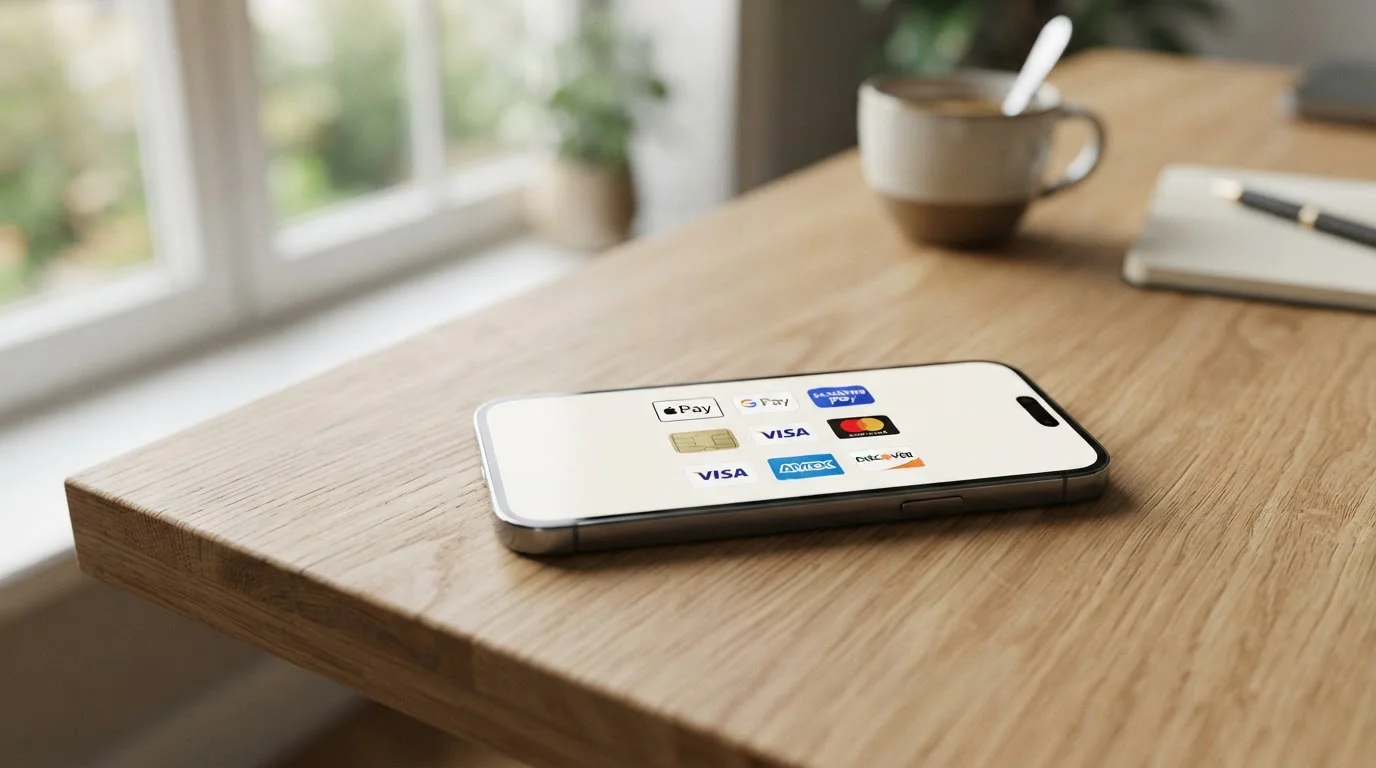
Apple Inc. launched Apple Pay in the UK in September 2015. A mobile wallet service, not a payment network: you add a debit or credit card to Apple Wallet on your iPhone, iPad, or Apple Watch, Apple generates a device-specific token called a Device Account Number, transactions route through Visa or Mastercard networks of the underlying card using that token instead of your actual card number. NFC at retail terminals, online via Safari on compatible devices. Requires iPhone 6 or later, Apple Watch, iPad Air 2 or mini 3 or later, Mac with Touch ID.
Acceptance at UKGC casinos sits around 40% to 50%, concentrated at mobile-optimized operators. You select Apple Pay in the mobile cashier, authenticate via Face ID or Touch ID on your device, payment confirms, funds credited instantly. Typical minimum £10, some casinos £5 or £20. Maximum per transaction varies by casino and the limits of your underlying linked card, often £3,000 per The Independent’s casino data. No fees to you from Apple or the casino. Your underlying card issuer may charge if it normally fees gambling transactions, but that’s identical to using the card directly.
Apple Pay is deposit-only at UK casinos. Withdrawals do not return to Apple Pay itself; they bypass the wallet and land in your underlying bank account or on your linked debit card. The casino asks for bank details separately at withdrawal time. This asymmetry confuses users who assume Apple Pay works bidirectionally because it’s linked to their bank. The technical reason: Apple Pay is a tokenization layer, not an account holding funds. There’s no Apple Pay balance to receive money. The token authorizes outbound payments only. Reverse payments would hit your underlying card or bank directly, which the casino can do without involving Apple Pay at all.
Security is the pitch. The casino never sees your actual card number, only the device token. If the casino’s database leaks, your card isn’t exposed. Biometric authentication beats typing a CVV. The convenience is frictionless: hold your phone, glance at it, payment done. No typing 16 digits or fetching a card from your wallet. The limitation is device lock-in: Apple Pay works only on Apple hardware. Android users are excluded. Desktop users are excluded unless they’re on a Mac with Touch ID and using Safari. Bonus eligibility is clean: deposits treated as card payments, qualify for welcome offers without exclusion.
Adoption among UK casino operators has grown but remains partial. Older platforms built before mobile wallets became standard haven’t retrofitted Apple Pay into legacy cashiers. Newer mobile-first casinos launched since 2018 commonly include it. If your primary casino doesn’t offer Apple Pay, you’re using a debit card anyway, so the gap doesn’t sting. If you’re shopping for a new casino and Apple Pay is a priority, filter for sites listing it explicitly. The deposit-only nature means you still need a withdrawal method: your linked bank account becomes the de facto withdrawal destination, so verify your bank details are registered before your first cashout attempt.
Google Pay
Google LLC launched Google Pay in the UK in 2016 as Android Pay, rebranded to Google Pay in May 2018. Mobile wallet service functionally parallel to Apple Pay: you add a debit or credit card to the Google Pay app on Android, Google generates a token, transactions route through Visa or Mastercard networks using that token. NFC at retail, online via Chrome. Requires Android 5.0 or later device with NFC, or Chrome browser on desktop. Google Wallet app replaced Google Pay branding in February 2024 in the UK, payment functionality unchanged.
Acceptance at UKGC casinos mirrors Apple Pay: 40% to 50%, often offered alongside Apple Pay at mobile-optimized sites. Instant deposits, authenticate via fingerprint or face unlock or PIN, funds credited. Minimum £5 to £10 typical, maximum £3,000 to £5,000 per transaction depending on casino and linked card limits. No fees to you from Google or the casino. Deposit-only: withdrawals bypass Google Pay and return to your linked bank account or debit card, same asymmetry as Apple Pay.
Google Pay’s advantage over Apple Pay is device breadth. Works on any NFC-enabled Android phone, covers a wider UK user base than Apple’s hardware-locked ecosystem. Also works in Chrome on desktop, which Apple Pay doesn’t unless you’re on a Mac with Touch ID. The tokenization security benefit matches Apple Pay: casino sees a token, not your card. Biometric auth identical. Bonus eligibility clean: treated as card payment, qualifies. The deposit-only limitation identical: you still need bank details registered for withdrawals.
Functionally, Google Pay and Apple Pay deliver the same casino experience from different hardware bases. If you’re an iPhone user, Apple Pay. If you’re Android, Google Pay. If you’re desktop-primarily and use Chrome, Google Pay works where Apple Pay doesn’t. The casino treats both identically: instant deposit, withdrawal to bank, no fees. Neither carries bonus penalties. The choice is dictated by your device, not by any meaningful difference in how they perform at UK casinos.
Pay by Mobile (Boku)
Boku Inc., founded 2008 in San Francisco, operates the dominant pay-by-mobile service in the UK through partnerships with EE, Vodafone, O2, and Three. You deposit via your phone number: enter it at the casino cashier, receive an SMS with a confirmation code, enter the code, payment authorized, charge added to your monthly phone bill if you’re on contract or deducted from pay-as-you-go credit if you’re prepaid. Funds credited to casino instantly. Alternative providers like Zimpler exist but Boku owns the majority share.
Acceptance at UKGC casinos around 40% to 50%, concentrated at casual-player and mobile-first operators. Minimum deposit typically £10, some casinos £5. Maximum £30 per transaction, a hard cap enforced by Boku and carriers for responsible-gambling reasons. Daily limits £80 to £90 depending on carrier. Monthly cap £400 cumulative across all merchants using Boku. If you deposit £30 at Casino A and £30 at Casino B in the same month via Boku, you’ve used £60 of your £400 monthly allowance. Pay-as-you-go users limited by available credit: you can’t overdraft a prepaid phone.
Fees: 30 pence flat per transaction is standard. Most casinos pass this to you: deposit £10, your phone bill shows £10.30. Three casinos operated by Betable Limited under UKGC licence 23328, IvyCasino, Oreels, and Bet442, absorb the fee and charge exactly £10 for a £10 deposit per Bokupaybymobile.co.uk testing. Elsewhere, budget for the 30p. No currency conversion fees: charge lands in GBP on your UK phone bill.
Pay by mobile is deposit-only structurally. You cannot reverse-bill a phone account, and carriers refuse payout traffic. Withdrawals require an alternative method: bank account, debit card, or e-wallet. The casino will prompt you to register one before your first cashout. Some casinos require a small verification deposit from your withdrawal method to confirm you control it. If you fund £50 via Boku and win £200, the £200 cannot return to your phone bill. It hits your bank account or card.
The appeal is accessibility and control. No bank account needed, no card needed, just a mobile phone. Unbanked users can deposit. The £30 cap and £400 monthly ceiling enforce hard spending limits, a harm-minimization feature. Casual players who want built-in budget guardrails get them automatically. The 30p fee stings on small deposits: 3% on £10, 1% on £30. Percentage-equivalent drops as you approach the £30 cap, but compared to zero-fee debit cards or e-wallets, Boku is the priciest per transaction. Bonus eligibility is clean: Boku deposits qualify for welcome offers, no systematic exclusion.
Usage is declining as mobile wallets like Apple Pay and Google Pay and instant bank transfers via Trustly offer faster deposits without the £30 cap or the 30p fee. Boku survives in the budget and casual segment: bingo players, slots-only accounts, younger demographics averse to linking bank accounts. If you’re depositing more than £30 regularly, Boku’s cap becomes a friction point, forcing multiple transactions or switching to another method. If you’re depositing £10 once a week for weekend play, Boku’s convenience outweighs the fee.
Are Apple Pay and Google Pay safe for casino deposits?
Yes, safer than entering your card details directly. Tokenization means the casino receives a device-specific token, not your actual card number. If the casino’s payment system gets breached or a rogue employee skims data, your card isn’t exposed. The token is useless outside the specific device-merchant pairing it was generated for. Biometric authentication via Face ID, Touch ID, or fingerprint prevents unauthorized use of your device: someone steals your phone, they can’t Apple Pay or Google Pay without your face or fingerprint. Transactions route through Visa or Mastercard networks using the same encryption and fraud-monitoring as direct card payments. The underlying card remains protected by your bank’s fraud detection. Apple and Google don’t share transaction details with the merchant beyond the token and authorization. From a data-security standpoint, mobile wallets layer more protection than typing your card number into a casino cashier. The trade-off is device dependency: lose your phone, you’ve lost access until you set up the wallet on a replacement. Both Apple Pay and Google Pay work only with debit cards at UKGC casinos because of the credit card ban; if you’ve added a credit card to your wallet, that card will be declined when you try to deposit.

Bank Transfers: Traditional and Instant
Traditional Bank Transfer
The legacy method: you initiate a manual bank transfer from your online banking to the casino’s merchant bank account. The casino provides sort code, account number, and a unique reference code tied to your player account. You log into your bank, set up the payee, enter the details, submit the transfer, notify the casino that payment is sent. UK domestic transfers via Faster Payments clear in minutes to two hours if submitted during banking hours. BACS takes three working days. CHAPS is same-day but costs £25 to £35 in bank fees, rarely used for casino deposits.
Acceptance at UKGC casinos remains high, around 90%, but operators actively discourage it. Deposit minimums for bank transfer often sit higher than other methods, £20 to £50, because manual reconciliation costs the casino time and operational overhead. The process is clunky: you leave the casino site, go to your bank, set up the payment, return to the casino, wait for confirmation. If you mistype the reference code, the casino’s payment team has to manually match your transfer to your account, adding hours or days. Faster Payments should land quickly, but the casino still needs to reconcile incoming funds against player accounts in batches, not real-time.
Withdrawals via traditional bank transfer reverse the flow. You provide your bank details in the casino account section, request a payout, the casino processes it, funds land in your bank account one to three days later via Faster Payments. Minimum withdrawals £10 to £20. No fees to you from UK banks for receiving Faster Payments. Some international casinos charge a withdrawal processing fee for bank transfer, but UKGC-licensed operators typically don’t.
Traditional bank transfer is declining. Players who would have used it a decade ago now use Trustly or debit cards instead. The method survives for high-roller deposits: moving five-figure sums feels safer via direct bank-to-bank transfer than via a card transaction that might get flagged by anti-fraud systems. Large withdrawals similarly default to bank transfer at VIP desks because payment processors cap card and e-wallet limits, leaving direct bank payout as the only route for £50,000-plus cashouts. For standard players depositing £50, bank transfer is inconvenient nostalgia.
Trustly and Open Banking (Instant Bank Transfer)
Trustly Group AB, founded 2008 in Stockholm, acquired by PayPal in May 2024 for $88 million pending regulatory approval, operates the leading Open Banking payment-initiation service in the UK. FCA-authorized under reference 585854 as a payment institution. Trustly doesn’t hold an account or store your money: it connects directly to your bank via Open Banking APIs mandated by PSD2, initiates a payment on your behalf, the money moves bank-to-casino in real time. You select Trustly or Instant Bank Transfer or Pay by Bank in the casino cashier, choose your bank from a list of 12,000-plus globally supported institutions, log into your own online banking via Trustly’s interface, authorize the payment, return to the casino with funds credited. Elapsed time: 30 seconds to two minutes.
Acceptance at UKGC casinos around 50% to 60% and growing fast. Trustly launched in the UK mid-2010s, adoption accelerated post-2018 when Open Banking became mandatory and banks opened APIs. Operators like the lower merchant fees: Trustly charges casinos roughly 0.8% per transaction, cheaper than card-processing fees of 1.5% to 3%. Players like the speed and lack of separate account registration. Minimum deposits £5 to £10. Maximum per transaction typically £5,000 to £10,000, constrained by your bank’s single-payment authorization limits rather than Trustly’s rails.
Withdrawals via Trustly are bidirectional. Request a payout, the casino sends funds to Trustly, Trustly pushes to your bank account, money arrives in under an hour typically. Betway clocked 50 minutes on a test withdrawal per Casino.org data. Not every casino enables Trustly withdrawals even if deposits work: some operators integrate only the deposit side, forcing traditional bank transfer for cashouts. Check the casino’s payment page. Where Trustly withdrawals are supported, they’re among the fastest routes in the UK market.
No fees to you from Trustly or the casino. The casino absorbs Trustly’s 0.8% merchant fee. No currency-conversion charges if the casino operates in GBP: the transaction is direct GBP bank-to-bank. If the casino operates in euros, conversion happens at your bank’s rate when the transaction crosses the border. No inactivity fees because there’s no Trustly account to go dormant. Bonus eligibility is clean: Trustly deposits qualify for welcome offers, treated as bank payments without exclusion.
Security runs on Open Banking’s read-only access model. Trustly never receives your banking login credentials. You authenticate directly with your bank via its own interface, embedded in Trustly’s flow but served from your bank’s servers. Trustly receives a one-time token to initiate this specific payment, not standing access to your account. The API is read-only for balance checks and transaction initiation, cannot pull funds without explicit authorization each time. PSD2 regulation enforces strong customer authentication, same two-factor flow as logging into your bank normally. If Trustly’s systems get breached, attackers gain no access to your bank: there are no stored credentials or standing permissions.
Trustly’s growth aligns with the broader Open Banking trend. Banks resisted API mandates initially, viewing third-party payment initiators as competitive threats. PSD2 forced compliance. Trustly bet early on the infrastructure, built integrations before the market matured, now dominates the UK instant-bank-transfer niche. PayPal’s acquisition in 2024 signals mainstream recognition: PayPal Holdings paying $88 million for Trustly legitimizes Open Banking as a permanent payment rail, not a niche experiment. Expect Trustly availability to expand as more UKGC casinos integrate it to cut card-processing costs and offer faster payouts.
What is Trustly and how does Open Banking work for casinos?
Trustly is a payment-initiation service using Open Banking APIs to connect your bank directly to the casino without a middleman account. Open Banking, mandated by EU PSD2 regulation in January 2018 and retained in UK law post-Brexit, requires banks to open secure APIs allowing licensed third parties to read account data and initiate payments with customer permission. Trustly holds an FCA payment-institution licence, accesses these APIs, builds a user flow where you select your bank, log in, authorize a payment, and Trustly tells your bank to send money to the casino’s merchant account. No Trustly account, no stored credentials, no funds held by Trustly. You’re using your bank’s infrastructure; Trustly is the messenger. The casino receives instant confirmation, credits your balance, the money has left your bank. Withdrawals reverse the flow: the casino instructs Trustly to send funds to your bank, Trustly pushes the payment, your bank credits your account within an hour. It’s faster than traditional bank transfer because there’s no manual setup or reference-code reconciliation, cheaper for casinos than card fees, and increasingly common at UK operators as the Open Banking ecosystem matures.

Prepaid Vouchers: Cash and Control
Paysafecard
Paysafecard, owned by Paysafe Group, launched in Austria in 2000, operates as a prepaid-voucher system. You buy a physical or digital voucher carrying a 16-digit PIN and a fixed value: £10, £25, £50, or £100. Purchase with cash at 28,000-plus UK retail outlets including PayPoint terminals, post offices, and newsagents, or buy online via the Paysafecard website using a debit card or bank transfer. Take the PIN to a casino cashier, enter it, the value deducts from the voucher, funds credited to your casino balance. No bank account required, no card needed, no personal information shared with the casino beyond the voucher code.
Acceptance at UKGC casinos sits around 30% to 40%, lower than cards and e-wallets but steady among budget-focused and casual-player operators. Premium brands less commonly offer it. Deposit minimums typically £10, matching the smallest voucher denomination. Maximum per transaction £100 for a single unregistered voucher. You can combine multiple PINs in one transaction if you’ve registered a my paysafecard account, raising the effective limit to £1,000 per transaction for verified users. Unregistered usage caps at £250 monthly cumulative across all merchants, an anti-money-laundering threshold under EU e-money regulations retained in UK law. Exceed £250 and you’ll need to register and verify identity.
Paysafecard is deposit-only by design. Prepaid instruments that accept inbound funds without KYC create money-laundering risk, so Paysafecard blocks reverse transactions. If you deposit £50 via Paysafecard PIN and win £200, the casino cannot send £200 back to a voucher. Withdrawals require an alternative method: you register a bank account, debit card, or e-wallet at the casino before cashing out. Some casinos tested Paysafecard withdrawals in limited markets, DaznBet offered it per Topendsports.com data, but the feature remains rare. Standard expectation: Paysafecard goes one way, your winnings come back another way.
Fees to you: none at the point of casino deposit. The casino absorbs Paysafecard’s merchant fee. Retail outlets add a markup when you buy the voucher, typically £1 to £2 on top of face value: buy a £25 voucher, pay £26 or £27 depending on the shop. Buying online via Paysafecard’s site avoids the retail markup but requires paying with a card or bank, defeating the cash-anonymity purpose. Inactivity fee: £3 per month after 12 months of no voucher use, deducted from the voucher balance. If you buy a £50 voucher, use £30, leave £20 unused for 13 months, you’ll find £17 left when you return. Currency conversion applies if you use a GBP voucher at a euro-denominated casino, around 2% to 3% markup.
Bonus eligibility is generally clean: Paysafecard deposits qualify for welcome offers at most casinos accepting it. Some operators exclude it due to the deposit-only nature, viewing it as bonus-abuse risk: deposit via Paysafecard, claim bonus, withdraw to bank, repeat. Check terms. Where eligible, Paysafecard works identically to debit cards for bonus purposes.
Paysafecard’s strengths are anonymity and budget control. Cash-purchased vouchers share zero personal data with the casino: they see a PIN, not your name, address, or bank details. Useful for privacy-focused players or those excluded from banking services. The fixed denominations enforce hard spending caps: you cannot spend more than the voucher value, no overdraft, no temptation to deposit "just a bit more." Harm-minimization tools are built into the structure. Retail availability is ubiquitous: 28,000 UK outlets mean you’re rarely far from a point of sale.
Weaknesses are the deposit-only limitation, the retail markup, the inactivity fee, and the £250 monthly cap for unregistered users. If you’re a regular player depositing £100 weekly, Paysafecard becomes inconvenient fast: you’ll hit the £250 cap in three weeks, forcing registration and KYC, eroding the anonymity benefit. The markup eats into value: paying £27 for £25 of casino funds is a 8% cost, steeper than Boku’s 30p and vastly pricier than zero-fee debit cards. The withdrawal friction adds steps: you still need a bank account or card registered somewhere to get your money out, so Paysafecard doesn’t eliminate banking entirely, just compartmentalizes it.
Usage is declining among younger players who default to mobile wallets and instant bank transfers. Paysafecard survives in niches: older demographics comfortable with cash, unbanked players, privacy purists, and parents buying vouchers for adult children’s controlled gambling. The market is shrinking but stable. Expect Paysafecard availability to persist at mid-tier UKGC casinos targeting budget and casual segments while premium operators quietly drop it from cashiers.
How Paysafecard Works
Buy a voucher in person or online. Physical vouchers print a receipt with a 16-digit PIN. Digital vouchers deliver the PIN via email or SMS. Navigate to your casino’s cashier, select Paysafecard, enter the 16-digit code, choose the amount to deposit up to the voucher’s remaining balance, confirm. The casino pings Paysafecard’s system to validate the PIN and check the balance, Paysafecard deducts the deposit amount from the voucher, confirms to the casino, your balance updates. If the voucher holds £50 and you deposit £30, £20 remains on the PIN for future use. Partial redemptions work across multiple merchants: use £10 at Casino A, £15 at Casino B, £25 at Casino C from the same £50 voucher.
Registered my paysafecard accounts add functionality. You create an account at paysafecard.com, upload ID for verification, link multiple PINs to the account. This raises the monthly spending cap from £250 to £10,000-plus, allows combining PINs for transactions over £100, and enables balance management via app. Registration kills anonymity: KYC means Paysafecard knows who you are, though the casino still sees only a transaction ID. The trade-off is convenience and higher limits versus privacy.
Lost or stolen PINs are gone. Paysafecard operates like cash: possession of the 16-digit code equals ownership. If someone photographs your voucher receipt or intercepts your email, they can drain it. No recourse, no chargebacks. Store PINs securely. Registered accounts offer marginally better protection: if your my paysafecard login gets compromised, you can contact support to freeze the account, but unregistered PINs are bearer instruments.
Voucher Limits and Fees
Unregistered: single voucher £10 to £100 depending on denomination purchased. Maximum £250 monthly cumulative across all merchants using Paysafecard. Exceed that and the system blocks further transactions until you register and verify. Registered: maximum £1,000 per transaction after KYC. Monthly caps rise to £10,000-plus depending on verification level. Retail markup £1 to £2 per voucher at point of purchase. Inactivity fee £3 per month after 12 months of no use, taken from voucher balance. Currency conversion ~2-3% if using GBP voucher at non-GBP casino.
Is Paysafecard accepted for casino withdrawals?
No, with rare exceptions. Paysafecard is structurally deposit-only. You can load a casino account with a PIN but cannot receive payouts to a PIN. Anti-money-laundering regulations prevent prepaid instruments from accepting reverse flows without full KYC. A tiny number of casinos experimented with Paysafecard withdrawals in specific markets: DaznBet offered it in one Topendsports.com test, but that’s an outlier. Standard expectation at 99% of UKGC casinos: Paysafecard deposits only, withdrawals via bank account, debit card, or e-wallet. You must register an alternative withdrawal method before your first cashout. The casino will prompt you to provide bank details or card information when you request a payout. Some operators require a small test deposit from your nominated withdrawal method to verify you control it. If you’ve deposited exclusively via Paysafecard and have no other payment method on file, expect the first withdrawal to involve extra verification steps and a 24-to-72-hour delay while the casino’s compliance team processes your bank details.
Speed Comparison: Which Methods Pay Out Fastest?
Deposit speed is near-universal: instant across debit cards, e-wallets, mobile wallets, Trustly, prepaid vouchers, and pay-by-mobile. Traditional bank transfer lags at one to three days, but operators discourage it for deposits anyway. The meaningful variable is withdrawal speed, where methods split into three tiers.
Fastest tier: e-wallets and Trustly. PayPal, Skrill, Neteller, and Trustly consistently clear withdrawals in under 24 hours at competent casinos, often within an hour at premium operators. Casino.org UK ran live withdrawal tests: Casumo processed a PayPal payout in 35 minutes, Betway cleared Trustly in 50 minutes, Ladbrokes paid Skrill in 45 minutes. These are best-case figures from top-tier casinos with automated approval systems. Mid-tier and budget operators stretch the same methods to 24 to 48 hours because their internal approval processes batch requests less aggressively. The payment method itself is fast; the casino’s workflow dictates actual delivery time.
Middle tier: debit cards. Standard Visa and Mastercard withdrawals take one to three business days. Fast Funds technology, where supported, compresses this to under an hour, matching e-wallet speeds. The catch: Fast Funds adoption is inconsistent. Some casinos integrate it, some don’t. Some issuing banks participate in Visa Direct and Mastercard Send schemes, some don’t. If all three parties align, your debit card withdrawal lands in an hour. If any link in the chain is missing, you default to one-to-three-day processing. Casumo clocked one-hour Visa payouts per testing data, but that’s not generalizable across all UKGC casinos.
Slow tier: traditional bank transfer. Three to five business days standard. The casino processes your request, sends funds via BACS or Faster Payments, your bank credits your account. Faster Payments should technically arrive in minutes to hours, but casinos batch bank-transfer payouts less frequently than card or e-wallet requests, adding delays. High rollers cashing out five-figure sums often default to bank transfer because card and e-wallet processors cap transaction limits, but they’re trading speed for capacity.
Casino processing windows matter more than payment-method speeds. A casino that batches withdrawals once daily at midnight will deliver identically slow PayPal and Trustly payouts despite the methods’ technical speed advantage. A casino with 24/7 automated approval pays out debit cards faster than a competitor who manually reviews every request during business hours. When comparing casinos, ask about withdrawal approval times, not just payment methods offered.
Table: Withdrawal Speed Ranking
| Method | Typical Speed | Fastest Recorded | Source | Casino Processing Note |
|---|---|---|---|---|
| PayPal | Under 24h | 35 minutes | Casino.org UK (Casumo) | Fastest at automated-approval casinos |
| Trustly | Under 1h | 50 minutes | Casino.org UK (Betway) | Depends on Open Banking integration |
| Skrill | Under 24h | 45 minutes | Casino.org UK (Ladbrokes) | Fastest at automated-approval casinos |
| Neteller | Under 24h | Comparable to Skrill | Industry standard | Similar to Skrill |
| Visa debit (Fast Funds) | Under 1h | 1 hour | Casino.org UK (Casumo) | Only where Fast Funds supported |
| Visa debit (standard) | 1-3 days | N/A | Industry standard | Most common debit card experience |
| Mastercard debit (Fast Funds) | Under 1h | Comparable to Visa | Industry standard | Only where Mastercard Send supported |
| Mastercard debit (standard) | 1-3 days | N/A | Industry standard | Most common debit card experience |
| Bank transfer (traditional) | 3-5 days | N/A | Industry standard | Declining usage |
What is the fastest withdrawal method for UK casinos?
PayPal, Skrill, Neteller, and Trustly tie for fastest when the casino’s approval process is automated. All four can deliver payouts in under an hour at premium operators like Casumo, Betway, and Ladbrokes. Debit cards with Fast Funds support match that speed where enabled, but adoption is inconsistent. If you prioritize withdrawal speed, register an e-wallet or use Trustly, then filter casinos by withdrawal reputation rather than method alone. A fast payment method at a slow casino still takes 48 hours. A standard payment method at a fast casino often beats the field.
How long do casino withdrawals take to reach my account?
Casino processing time plus payment-method speed. First withdrawal at any casino adds 24 to 72 hours for identity verification: passport, proof of address, sometimes source-of-funds documentation. Subsequent withdrawals at a verified account skip that delay. The casino then reviews your request: instant at automated systems, up to 48 hours at manual-review casinos. Once approved, the payment method’s speed kicks in. E-wallets and Trustly: under 24 hours, often within an hour. Debit cards: one to three days standard, under an hour with Fast Funds where supported. Bank transfer: three to five days. Total time from request to funds in bank account: fastest case under two hours (automated casino, e-wallet payout), slowest case one week (manual casino, first withdrawal, bank transfer). Average case 24 to 72 hours for e-wallets at mid-tier casinos.

Fees and Costs: What You Actually Pay
Most UK casino payment methods charge you nothing directly. Casinos absorb merchant fees to keep deposits frictionless. The exceptions and hidden costs:
Boku charges 30 pence per transaction, passed to the player by most casinos. Deposit £10, your phone bill shows £10.30. Three casinos operated by Betable Limited, IvyCasino, Oreels, and Bet442 under UKGC licence 23328, absorb the fee and charge face value. Elsewhere, budget for 30p. That’s 3% on a £10 deposit, 1% on the £30 cap. Percentage-cost declines as you approach the limit, but Boku remains the priciest method per transaction.
E-wallet currency conversion eats value. Skrill charges 1.45% above mid-market rate if the casino operates in a non-GBP currency. Neteller charges 1.50%. PayPal charges 3% to 4%. If you deposit at a euro-denominated casino from a GBP e-wallet, you pay the conversion markup. Solution: select GBP as your currency at casino signup if the site offers multi-currency accounts, avoiding conversion entirely. If the casino forces euro accounts for UK players, Skrill’s 1.45% beats PayPal’s 3-4%.
E-wallet instant-withdrawal fees apply when you move money from the wallet to your bank. Skrill charges £1 for instant UK bank transfer via Faster Payments, free for one-to-three-day standard transfer. Neteller charges £1 to £5 depending on amount. PayPal charges nothing for UK bank transfers. These fees hit when you withdraw from the e-wallet to your bank, not when the casino pays the e-wallet. Many players leave balances in their e-wallets to avoid the fee, using the wallet for multiple casinos and only cashing out to bank occasionally.
E-wallet inactivity fees punish dormant accounts. Skrill: £5 per month after 12 months of no login. Neteller: £10 per month after 6 months of no transaction. PayPal: no inactivity fee. If you fund an e-wallet, use it once, forget about it for a year, you’ll return to a drained balance. Set calendar reminders or log in quarterly with a trivial transaction to reset the clock.
Paysafecard retail markup is 8% to 10% typically. Buy a £25 voucher, pay £26 to £27 at the shop. Online purchase avoids markup but requires a card or bank, negating the cash-anonymity point. Paysafecard inactivity fee: £3 per month after 12 months. Currency conversion ~2-3% at non-GBP casinos.
Debit cards, Trustly, Apple Pay, and Google Pay charge you nothing in normal use. No deposit fees, no withdrawal fees, no inactivity fees, no conversion fees if transacting in GBP. Your bank might levy a gambling-transaction fee on its side, check account terms, but that’s rare and bank-specific. These methods are zero-cost from a payment-method perspective.
Table: Fee Breakdown
| Method | Deposit Fee | Withdrawal Fee | Currency Conversion | Other Fees |
|---|---|---|---|---|
| Visa / Mastercard debit | None | None | None (GBP-GBP) | Possible bank gambling fee (rare) |
| PayPal | None | None | 3-4% (non-GBP casino) | None |
| Apple Pay | None | N/A (deposit-only) | None (GBP-GBP) | None |
| Google Pay | None | N/A (deposit-only) | None (GBP-GBP) | None |
| Skrill | None | £1 instant to bank | 1.45% (non-GBP casino) | £5/month inactivity after 12 months |
| Neteller | None | £1-£5 instant to bank | 1.50% (non-GBP casino) | £10/month inactivity after 6 months |
| Trustly | None | None | None (GBP-GBP) | None |
| Paysafecard | Retail markup £1-£2 | N/A (deposit-only) | 2-3% (non-GBP casino) | £3/month inactivity after 12 months |
| Boku | 30p per transaction | N/A (deposit-only) | None (GBP billing) | None |
Do online casinos charge fees for deposits or withdrawals?
UKGC-licensed casinos rarely charge player-facing fees for deposits or withdrawals. The casino absorbs merchant fees from payment processors as a cost of business. Exceptions: some casinos levy a withdrawal-processing fee for traditional bank transfer, typically £1 to £5, flagged in payment terms. High-roller withdrawals above certain thresholds might incur admin fees at specific operators. Standard play at mainstream casinos: zero fees from the casino for deposits, zero fees for withdrawals via e-wallet or debit card or Trustly. The fees that do exist come from the payment method itself: Boku’s 30p, e-wallet currency conversion, e-wallet instant-withdrawal charges, e-wallet inactivity fees, Paysafecard retail markup. Read the payment method’s terms, not just the casino’s.
Bonus Eligibility: Which Methods Qualify?
Welcome bonuses at UKGC casinos require a qualifying deposit via specific payment methods. Debit cards, PayPal, Trustly, Apple Pay, Google Pay, Boku, and Paysafecard typically qualify without restriction. Skrill and Neteller face systematic exclusion at roughly 50% to 60% of casinos that accept them. Deposit with Skrill, forfeit the bonus. Deposit with a debit card, claim the bonus. The exclusion stems from bonus-abuse history: Skrill and Neteller made it frictionless to cycle money between casinos, claiming multiple bonuses in rapid succession. Operators flagged these wallets as higher-risk for arbitrage and blacklisted them from promotions.
Secondary e-wallets like MuchBetter, Payz, MiFinity, and AstroPay sometimes qualify where Skrill and Neteller don’t. Casinos treat them as lower-risk because their UK user bases are smaller and less associated with professional bonus hunters. The pattern isn’t universal: always check the specific casino’s bonus terms before depositing. Terms sections list excluded payment methods explicitly, usually buried in paragraph 8 or 9 of the welcome-offer fine print.
The same exclusion logic applies to reload bonuses, cashback offers, and free-spin promotions. If Skrill is excluded from the welcome bonus, it’s typically excluded from all promotional offers at that casino. The block is account-wide, not offer-specific. Players who value bonuses register a debit card or PayPal, claim the offer, then switch to Skrill for subsequent deposits after the bonus clears if Skrill’s faster withdrawals matter.
Table: Bonus Eligibility
| Method | Welcome Bonus Eligibility | Exclusion Rate | Notes |
|---|---|---|---|
| Visa / Mastercard debit | Qualifies | 0% | Universal acceptance |
| PayPal | Qualifies | ~5% | Rarely excluded |
| Apple Pay | Qualifies | ~5% | Treated as card payment |
| Google Pay | Qualifies | ~5% | Treated as card payment |
| Trustly | Qualifies | ~5% | Treated as bank payment |
| Boku | Qualifies | ~10% | Occasionally excluded due to deposit-only nature |
| Paysafecard | Qualifies | ~10% | Occasionally excluded due to deposit-only nature |
| Skrill | Often excluded | ~50-60% | Bonus-abuse history |
| Neteller | Often excluded | ~50-60% | Same as Skrill |
| MuchBetter | Sometimes qualifies | ~30% | Lower exclusion than Skrill/Neteller |
| Payz | Sometimes qualifies | ~30% | Similar to MuchBetter |
| MiFinity | Sometimes qualifies | ~35% | Less common acceptance |
| AstroPay | Usually qualifies | ~20% | Limited acceptance overall |
UK Regulation and Payment Methods
The Credit Card Ban Explained (LCCP 6.1.2)
The UK Gambling Commission banned credit cards for all gambling transactions at licensed operators effective April 14, 2020. Licence Condition and Code of Practice 6.1.2 prohibits UKGC licensees from accepting credit card payments for online casino, sports betting, bingo, lottery, poker, and any other gambling product. The rule covers credit cards issued on Visa, Mastercard, American Express, and any other network, regardless of issuing country. A UK player cannot use a US-issued Amex at a UKGC casino. The ban is absolute within the licensed market.
The regulation extends to indirect credit-card funding. You cannot load an e-wallet like Skrill or PayPal with a credit card and then deposit from that e-wallet to a casino. UKGC rules require e-wallet providers to verify and block credit-card sources for gambling transactions. Operators must check that incoming e-wallet deposits are funded by debit cards, bank transfers, or prepaid instruments, not credit. Compliance mechanisms vary: some e-wallets block gambling-categorized merchants from receiving credit-funded balances at the API level, others require manual declaration from operators.
The rationale: borrowing to gamble amplifies harm. UKGC research and interventions by debt charities showed gamblers using credit cards were disproportionately likely to develop problem-gambling behaviors, accumulate unserviceable debt, and require financial-harm support. The ban followed consultation periods where industry stakeholders argued that responsible adults should have the freedom to choose their payment methods, but the harm data overrode those objections. Credit cards let you spend money you don’t have. Debit cards limit you to your actual balance. The regulatory line: if you’re gambling, use your own funds, not borrowed capital.
Enforcement is strict. UKGC compliance audits check payment-processing logs. Operators caught accepting credit card deposits face licence sanctions, fines, or revocation. Payment processors operating in the UK market built credit-card-blocking logic into their gateways: transactions tagged with Merchant Category Code 7995 for gambling decline automatically when the funding source is identified as credit. The system isn’t perfect. Some credit cards issued as debit-credit hybrids slip through categorization gaps, but those are rare edge cases, not systemic loopholes.
Offshore casinos licensed in Malta, Curacao, Gibraltar, or other jurisdictions still accept UK players’ credit cards. Those sites operate outside UKGC jurisdiction. Playing there isn’t criminal under UK law for the player: the Gambling Act 2005 criminalizes unlicensed operators offering services to UK consumers, not consumers placing bets. The risk is consumer-protection absence. UKGC-licensed casinos segregate player funds, submit to dispute resolution, cap wagering requirements at 10x since January 2026, and face enforcement for violations. Offshore casinos offer none of those safeguards. Use credit cards there if you choose, but recognize you’re outside the regulatory perimeter.
KYC and Identity Verification Requirements
Every UKGC casino requires identity verification before your first withdrawal. Know Your Customer regulations under anti-money-laundering law mandate that operators verify who you are, where you live, and that funds aren’t proceeds of crime. First-withdrawal KYC delays cashouts by 24 to 72 hours while the compliance team reviews documents.
You upload a government-issued photo ID: passport, driving licence, or national identity card. The casino checks it against your registered name and date of birth. You upload proof of address dated within the last three months: utility bill, bank statement, council tax notice, or government correspondence showing your name and residential address. The casino checks it against your registered address. For large deposits or withdrawals, typically £2,000-plus cumulative, the casino requests source-of-funds documentation: payslips, bank statements showing income, sale-of-asset records, inheritance documents, or other evidence that your gambling funds are legitimate.
The process is one-time per casino at a verified account. Deposit and play immediately, but the first withdrawal triggers document requests. Some casinos run verification proactively after your first deposit, emailing document requests before you win anything, smoothing the eventual cashout. Others wait until you request a payout. Timelines: 24 hours at efficient casinos with automated document-reading systems, 48 to 72 hours at slower operators with manual compliance queues.
Payment methods don’t change KYC requirements. Debit cards, e-wallets, Trustly, Paysafecard, all face identical verification before first withdrawal. The method affects deposit and payout speed; it doesn’t let you skip compliance. Anonymous gambling doesn’t exist at UKGC-licensed casinos. Paysafecard preserves privacy from the casino at deposit but you still upload ID before cashing out. Offshore casinos occasionally offer no-KYC withdrawals under certain thresholds, but that’s outside UKGC jurisdiction and comes with attendant risks: no dispute resolution, no segregated funds, no regulatory recourse if the casino refuses payout.
GamStop and Self-Exclusion Tools
GamStop is the UK’s national self-exclusion scheme, mandatory for all UKGC-licensed operators. Register at gamstop.co.uk, your details propagate to every licensed casino, betting site, bingo hall, and lottery in the UK market. You’re blocked from opening accounts or depositing at any UKGC casino for the exclusion period you selected: six months, one year, or five years. The block is irreversible during the term. Payment methods don’t bypass it: if you’re on GamStop, debit cards, e-wallets, Trustly, and every other route are blocked by the casino’s registration system before you reach the cashier.
Self-exclusion at individual casinos works similarly. You request exclusion via account settings or customer support, the casino blocks your account, you cannot deposit or play. Some players attempt to circumvent exclusions by registering new accounts with different email addresses or payment methods. UKGC rules require operators to detect and block such attempts via identity-matching algorithms: same name, date of birth, address, or partial matches trigger fraud checks. Payment methods like Paysafecard that don’t share personal data at deposit don’t help: the casino still verifies your identity at registration before you’re allowed to play, closing the bypass route.
Deposit limits are another harm-minimization tool. You set daily, weekly, or monthly deposit caps in your account settings. The casino enforces them across all payment methods. If you set a £50 weekly limit, attempts to deposit £60 via debit card or £20 via Skrill after already depositing £40 that week will be declined. The limit persists through cool-off periods: you can’t cancel a deposit limit immediately, UKGC rules mandate 24-hour delays on limit increases to prevent impulsive raising during a gambling session.
Payment methods interact with these tools transparently. Trustly, e-wallets, debit cards all respect GamStop blocks and deposit limits. Boku’s £30 cap and £400 monthly ceiling add an extra control layer on top of casino limits. Paysafecard’s £250 monthly cap for unregistered users similarly constrains spending. The regulatory framework stacks multiple barriers: casino-level limits, payment-method-level limits, and national self-exclusion all operating simultaneously.

Choosing the Right Payment Method for You
If Speed Is Your Priority
Register an e-wallet or use Trustly. PayPal, Skrill, Neteller, and Trustly deliver the fastest casino-to-bank-account turnaround in the UK market: under 24 hours at competent casinos, as fast as 35 to 50 minutes at premium operators with automated approval systems. Debit cards match that speed only where Fast Funds is supported, which remains inconsistent. Filter casinos by withdrawal reputation, not just method availability. A fast payment method at a slow casino still takes two days. Look for operators advertising instant or same-day withdrawals, check user reviews on payout speed, test with a small withdrawal before committing larger sums.
PayPal edges ahead if you value mainstream brand trust and already hold an account. Skrill and Neteller offer marginally faster speeds at gambling-focused casinos but carry bonus-exclusion penalties. Trustly requires no separate account, works directly from your bank, and increasingly matches e-wallet speeds as Open Banking matures. Avoid traditional bank transfer entirely if speed matters: three-to-five-day lag is uncompetitive. Avoid deposit-only methods like Paysafecard and Boku because they force you onto a slower withdrawal alternative.
If Privacy Is Your Priority
Paysafecard delivers the highest anonymity: cash-purchased vouchers share zero personal data at deposit, the casino sees only a 16-digit PIN. You still upload ID before your first withdrawal due to KYC regulations, so anonymity is deposit-side only, but if you’re concerned about card or bank details entering casino databases, Paysafecard keeps that compartment sealed. The catch: deposit-only, so you need a bank account or card registered for cashouts, partially defeating the privacy purpose. The retail markup and £250 monthly cap add friction.
E-wallets offer a middle ground. PayPal, Skrill, Neteller, and secondary wallets keep your card and bank details away from the casino: the operator sees a transaction ID from the e-wallet, not your underlying financials. The e-wallet itself holds your data, so you’re trusting one intermediary instead of dozens of casinos, a concentration of risk but arguably better than spreading card numbers across every gambling site you join. Trustly uses read-only Open Banking access, no stored credentials, but the casino still knows which bank you use. Debit cards expose your card number to the casino’s payment processor, the lowest privacy option.
Privacy-conscious players use Paysafecard for deposits, an e-wallet for withdrawals, and register minimal personal information during signup. That combination limits data spread while maintaining functional access to payouts.
If Budget Control Is Your Priority
Boku and Paysafecard enforce hard spending caps. Boku stops you at £30 per transaction and £400 monthly, structural limits you cannot exceed. Paysafecard vouchers cap at £100 each, £250 monthly cumulative for unregistered users, £1,000 per transaction for registered accounts. Both methods make it physically impossible to overspend beyond the limits: no overdraft, no borrowing, no impulse raising of deposit ceilings mid-session. These are harm-minimization tools built into the payment structure.
Combine payment-method limits with casino deposit caps. Set a weekly or monthly deposit limit in your account settings, choose a payment method with its own ceiling, and stack the barriers. Boku’s £400 monthly cap layered on top of a casino £300 monthly limit means you hit £300 and stop, the Boku ceiling acting as a secondary brake if you attempt circumvention via a new casino. Paysafecard’s fixed denominations similarly enforce discipline: buy two £25 vouchers for the week, when they’re spent, you’re done until next week.
Avoid credit cards entirely (already banned at UKGC casinos). Avoid e-wallets if you’re prone to chasing losses: Skrill and Neteller make it frictionless to reload, defeating the point of a budget. Debit cards respect your bank balance but don’t impose spending caps beyond your available funds, which can be substantial if you’ve just been paid. Trustly similarly accesses your bank without friction. For players who need external constraints, Boku and Paysafecard are purpose-built controls.
If Simplicity Is Your Priority
Use your debit card. Visa and Mastercard work everywhere, cost nothing, require no separate account registration, and handle both deposits and withdrawals. You’re already carrying the card for non-gambling purchases; no additional setup needed. Deposit instantly, withdraw in one to three days, done. Fast Funds availability is a bonus where supported, but even standard debit-card processing beats the complexity of managing e-wallet balances or buying prepaid vouchers.
Trustly runs a close second for simplicity-focused players. No separate account, no app download, no voucher purchase, just select your bank from a list, log in as you normally would, authorize the payment. Instant deposits, sub-one-hour withdrawals where supported. The Open Banking integration makes Trustly feel like an extension of your bank rather than a separate payment service. If your casino offers Trustly and you’re comfortable with Open Banking security, it matches debit cards for simplicity while delivering faster withdrawals.
Avoid e-wallets if simplicity is your filter: they require separate registration, funding the wallet from your bank, managing an additional account, tracking inactivity fees, and withdrawing from the wallet to your bank after cashing out from the casino. That’s three steps (bank to wallet, wallet to casino, casino to wallet, wallet to bank) versus one step (bank to casino, casino to bank) for debit cards or Trustly. Avoid Paysafecard: retail purchase, voucher management, PIN entry, registration if you exceed £250 monthly, and mandatory alternative withdrawal method add friction. Avoid Boku: 30p fee and £30 cap mean constant top-ups for regular play. Debit cards or Trustly streamline the entire cycle into familiar banking workflows.
Created by the ”Payments-casino-uk (9)” editorial team.